
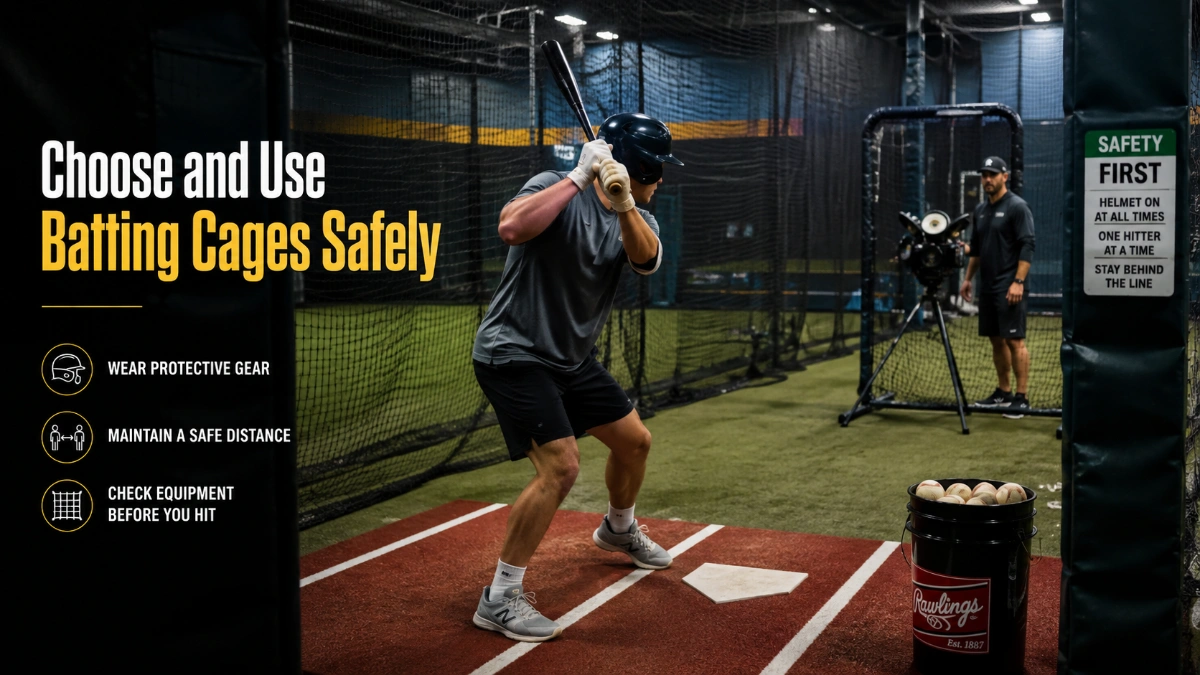
Batting Cages: A Practical Guide to Choosing, Booking, and Using Them
Batting cages provide a controlled environment for baseball and softball players who want focused hitting practice. They can make it easier to repeat a particular movement, work on timing, track the ball, and develop consistency without needing a full field for every session.
But choosing a cage is more than finding the closest facility.
The right setup depends on the sport, ball type, feed method, machine configuration, equipment, lane condition, supervision requirements, booking format, and the purpose of the session. Safety and suitability should come before speed, repetition count, or convenience.
Whether you are a beginner, parent, coach, recreational player, or experienced hitter, this guide explains how to compare batting cages, understand rental options, evaluate pitching-machine setups, prepare for a session, practice with purpose, and decide whether a facility is worth using again.
Safety note: Facility rules always take priority. Requirements vary by venue, age group, sport, equipment, machine type, league, and local organization. Always follow the instructions posted at the facility and the requirements that apply to your particular session.
What Are Batting Cages?A batting cage is an enclosed practice area designed to contain balls during hitting drills. Depending on the facility, a cage may use a pitching machine, coach-fed balls, staff-fed balls, or another approved feeding system.
The biggest practical benefit is controlled repetition. A hitter can work repeatedly on a defined skill without needing a complete baseball or softball field for every practice.
However, a cage does not automatically reproduce every condition of live play.
A fixed machine or controlled feed may not reproduce changing release cues, pitch movement, varying locations, defensive situations, decision-making, or game pressure.
That makes cages most useful as one component of a broader practice plan, rather than as a complete replacement for every form of baseball or softball training.
What Makes a Good Batting Cage?
A good cage is not necessarily the facility with the fastest machine, newest building, or longest operating hours.
A useful setup should match:
- The player’s sport
- The ball being used
- The hitter’s experience level
- The intended practice objective
- The available machine or feed system
- The facility’s safety rules
- Required protective equipment
- Lane and net condition
- Booking format
- Age and supervision requirements
- The equipment the player is permitted to bring or use
The best facility is therefore the one that provides the right environment for the specific practice session.
Types of Batting Cages
Not every cage is configured for the same purpose. Identify the type of practice you need before booking.
Baseball Batting Cages
Baseball-focused lanes may use equipment and settings designed around baseballs and baseball-oriented pitching or feeding patterns.
Before using one, confirm:
- The lane supports baseball.
- The ball type is appropriate.
- The pitching machine or feed system is compatible.
- Available settings suit the intended practice.
- The facility permits the bat and other equipment you plan to use.
- The cage configuration is appropriate for the drill.
A baseball cage should not automatically be assumed to support every form of baseball practice. Machine-fed repetition and live pitching serve different training purposes.
Softball Batting Cages
Softball cages can differ from baseball setups in ball type, machine configuration, and available settings.
Fastpitch and slow-pitch softball also have different practice requirements, so do not assume that a facility advertised simply as a “batting cage” supports every softball format.
Ask specifically about:
- Fastpitch compatibility
- Slow-pitch compatibility
- Ball type
- Machine type
- Available settings
- Lane configuration
- Booking requirements
- Approved equipment
Indoor Batting Cages
Indoor facilities can provide a more predictable environment when rain, daylight, temperature, or other outdoor conditions interfere with practice.
Check:
- Lane dimensions
- Lighting
- Ventilation
- Hitting-surface condition
- Equipment availability
- Operating hours
- Reservation rules
- Age and supervision policies
- Staff-contact procedures
Indoor does not automatically mean better. Equipment, lane condition, rules, and booking terms still determine whether the facility is appropriate.
Outdoor Batting Cages
Outdoor cages can work well when equipment, lane condition, lighting, weather, schedule, and operating rules suit the session.
Because outdoor conditions can change, verify the facility’s current operating status before travelling.
How to Choose the Right Batting Cages
Distance should be only one factor.
A better approach is to compare the facility against the exact practice session you want to complete.
| Practice Need | What to Look For | What to Verify |
| First youth session | Clear rules and suitable equipment | Age policy, supervision, helmet requirements |
| Baseball contact work | Baseball-compatible setup | Ball type, machine type, available settings |
| Fastpitch softball | Fastpitch-compatible equipment | Ball compatibility and machine configuration |
| Slow-pitch softball | Appropriate slow-pitch setup | Feed method and facility rules |
| Regular practice | Reliable, repeatable setup | Hours, booking and cancellation policy |
| Team session | Group-friendly space | Group limits, rental conditions and supervision |
| Beginner practice | Controllable setup | Suitable difficulty and operator rules |
| Self-service use | Clearly defined process | Eligibility and machine-operation requirements |
| Weather-proof practice | Indoor environment | Operating schedule and lane availability |
| Focused machine work | Consistent pitching setup | Machine type, settings and operator requirements |
A facility that looks impressive but cannot provide the correct sport, ball, equipment, or practice format may be less useful than a simpler facility with a suitable setup.
A 60-Second Batting Cage Selection Framework
When comparing facilities, use this sequence:
Sport → Ball → Feed → Safety → Equipment → Cost → Booking
1. Sport
Is the lane designed or approved for your baseball or softball format?
2. Ball
What ball will be used, and is it compatible with the machine and intended practice?
3. Feed
Will the session use a pitching machine, coach feed, staff feed, or another system?
4. Safety
Are helmet, gate, supervision, machine-operation, and lane-access rules clear?
5. Equipment
What does the facility provide, and what personal equipment is permitted?
6. Cost
What exactly does the advertised rental price include?
7. Booking
Is the lane private or shared? How long is the session? What happens if the lane or machine becomes unavailable?
This framework prevents a common mistake: choosing a facility because it looks convenient before checking whether it can actually deliver the desired practice session.
How to Find Batting Cages Near You
A search for batting cages near me can produce many options, but proximity alone should not determine the choice.
When comparing local facilities, evaluate:
- Travel time: Consider the complete journey rather than mileage alone.
- Sport compatibility: Confirm baseball, fastpitch, or slow-pitch suitability.
- Equipment: Check whether bats, helmets, balls, and machines are provided.
- Booking: Determine whether reservations are required.
- Lane format: Ask whether the lane is private, shared, or facility-controlled.
- Age policy: Confirm youth restrictions and supervision requirements.
- Machine operation: Find out who may adjust or operate the machine.
- Facility condition: Look for clear safety procedures and maintained equipment.
- Schedule: Verify current hours before travelling.
- Rental terms: Check cancellation, rescheduling, and equipment policies.
How to Compare Two Nearby Facilities
Suppose Facility A is closer but offers only shared lanes, while Facility B is farther away but offers a private lane and the exact machine configuration you need.
The closer facility is not automatically the better choice.
| Factor | Facility A | Facility B |
| Travel time | Shorter | Longer |
| Lane type | Shared | Private |
| Sport compatibility | Confirm | Confirm |
| Machine setup | Basic | Specific setup available |
| Equipment | Facility-dependent | Facility-dependent |
| Cost | Compare total session cost | Compare total session cost |
| Practice objective | May be suitable | May be better suited |
The better option depends on the purpose of the session, not simply distance.
Reviews can help identify recurring customer concerns, but they should not replace direct verification of safety rules, equipment compatibility, or current operating policies.
A Better Way to Evaluate Local Batting Cages
For local-search decisions, use a two-stage process.
Stage 1: Eliminate unsuitable facilities
Remove any facility that:
- Does not support the required sport
- Uses an incompatible ball or machine
- Cannot meet age or supervision requirements
- Has unclear or unsuitable safety procedures
- Does not offer the required booking format
- Cannot accommodate the intended practice objective
Stage 2: Compare the remaining facilities
Then compare:
- Total cost
- Travel time
- Lane privacy
- Equipment included
- Machine/feed configuration
- Booking reliability
- Facility condition
- Staff support
- Accessibility
- Ease of repeating the same setup
This approach is more useful than relying on star ratings alone because it evaluates facilities against the player’s actual requirements.
Batting Cage Dimensions: Why Size Matters
Batting cage dimensions affect how a space can be used, but there is no single universal cage size that applies to every facility, machine configuration, training objective, or installation.
Relevant dimensions can include:
- Overall cage length
- Cage width
- Net height
- Hitter position
- Pitching-machine position
- Space behind the hitter
- Clearance around equipment
- Entry and exit configuration
- Usable hitting area
Common Batting Cage Size Considerations
Commercial and training setups vary significantly. Dimensions should therefore be treated as configuration-specific information rather than universal standards.
| Dimension | Why It Matters |
| Length | Determines available distance between hitter and feeder or machine |
| Width | Affects usable swing and equipment clearance |
| Height | Provides overhead clearance and affects net configuration |
| Hitter position | Determines practical distance from the feed |
| Machine position | Changes effective setup and required clearance |
| Net clearance | Helps maintain containment and equipment access |
For a facility user, the most important question is whether the specific lane provides enough usable space for the intended activity under that facility’s rules.
For a backyard batting cage, dimensions become even more important. Available property, clearance, netting, machine placement, hitting position, installation method, and applicable local requirements should be evaluated before installation.
Do not assume that advertised overall dimensions automatically describe the usable hitting area.
Batting Cage Rental: What to Know Before Paying
Batting cage rental formats vary considerably between facilities.
A rental may involve:
- A private lane
- A shared lane
- A fixed-length session
- An hourly booking
- A team or group reservation
- A machine-based session
- A facility membership
- Walk-in access, where available
Before paying, determine exactly what the booking covers.
Questions to Ask About Batting Cage Rental
- Is the lane private or shared?
- How long is the session?
- Is the pitching machine included?
- Are balls included?
- Are bats included?
- Are helmets included?
- Can personal equipment be used?
- Who operates or adjusts the machine?
- Are there additional equipment charges?
- Are group bookings allowed?
- Are reservations required?
- What is the cancellation policy?
- What happens if the machine becomes unavailable?
- Can the session be rescheduled?
- Are peak and off-peak booking rules different?
What Determines Batting Cage Cost?
There is no universal price for batting cages because facilities differ by location, equipment, operating model, session length, and booking format.
Factors that may influence total cost include:
- Location
- Indoor or outdoor setting
- Session duration
- Private or shared lane
- Machine type
- Equipment rental
- Group or individual booking
- Membership status
- Peak or off-peak scheduling
- Special facility offerings
The most useful pricing question is not simply:
“How much does a batting cage cost?”
It is:
“What does the total price include for the exact session I am booking?”
A lower advertised price may not represent the lower total cost if equipment, machine use, or additional fees are separate.
Always check the current rate for the specific facility and session.
Pitching Machines in Batting Cages
A pitching machine can provide repeatable feeds for batting practice, but machines differ in design, operation, settings, ball compatibility, and facility policies.
Before using one, verify:
- What type of ball the machine is designed for
- Whether it is intended for baseball or softball
- Who is permitted to operate it
- Which settings visitors may adjust
- Whether staff assistance is required
- Whether the facility has specific operating instructions
- Whether the machine is compatible with the particular ball and bat setup being used
A machine’s displayed speed should not automatically be interpreted as equivalent to the experience of facing live pitching.
Machine-fed practice can be useful because repetition is predictable. Live pitching, however, introduces changing release cues, movement, location, and decision-making that a fixed machine setup may not reproduce.
Never Modify a Pitching Machine Yourself
If a machine behaves unexpectedly:
- Stop the session.
- Move away from the equipment as directed.
- Notify staff.
- Follow the facility’s instructions.
- Do not attempt an unauthorized repair or modification.
Commercial equipment can have system-specific operating requirements. Follow the facility’s instructions and the manufacturer’s instructions rather than assuming all machines operate the same way.
Safety Comes First at Batting Cages
Batting cages combine moving equipment, pitched or fed balls, bats, netting, and confined hitting areas. Safe operation therefore depends on following facility rules and keeping people away from active equipment.
Protect the Active Lane
- Wear the helmet required by the facility.
- Use additional protective equipment required by the venue, league, or organization.
- Keep gates closed whenever the facility requires them to be closed.
- Keep non-participants outside the protected hitting area.
- Do not take practice swings outside approved areas.
- Never reach toward an active pitching machine or feed mechanism.
- Do not attempt to repair, reset, modify, or override equipment.
- Stop the session and notify staff if equipment behaves unexpectedly.
- Report damaged netting, gates, cords, surfaces, or other equipment.
- Follow the facility’s age, supervision, and operator requirements.
Understanding Helmet and Equipment Standards
Equipment standards and facility rules are not necessarily the same thing.
NOCSAE maintains baseball and softball equipment standards, including specifications for newly manufactured batter helmets and recertified baseball/softball batter and catcher helmets. Its current standards library identifies ND022 for newly manufactured baseball/softball batter helmets and ND026 for recertified baseball/softball batter and catcher helmets.
The current NOCSAE ND026-24 specification for recertified baseball/softball batter and catcher helmets became effective March 3, 2025.
These standards do not replace the rules of a particular facility or league.
For example, Little League maintains current regulations, playing rules, equipment information, and operating policies for its baseball, softball, and Challenger programs. Its 2026 rulebook resources are updated for the current season.
Therefore:
Equipment standard → League rule → Facility rule
should be treated as three potentially different layers of requirements.
If Something Looks Unsafe
Do not try to fix the problem yourself.
Instead:
- Stop using the lane.
- Move away from the equipment as directed by the facility.
- Tell a staff member what happened.
- Follow the facility’s instructions before resuming.
- If the problem cannot be resolved safely, end the session.
A well-managed facility should make its operating rules visible and provide a clear way to contact staff.
What to Check Before Booking Batting Cages
Before paying, confirm the specific lane and session format, not merely the date and time.
Questions to Ask the Facility
- Does the lane support baseball, fastpitch softball, or slow-pitch softball?
- What type of ball is used?
- Is the session machine-pitched, coach-fed, staff-fed, or another format?
- What speed or difficulty settings are available?
- Who is allowed to adjust the machine?
- Does the facility provide helmets?
- Are bats and balls provided?
- Can visitors bring their own equipment?
- What are the age and supervision rules?
- Are waivers required?
- What footwear is permitted?
- Is the booking private or shared?
- Are walk-ins accepted?
- Are reservations required?
- Is the lane available for team rental?
- What happens if the machine or lane becomes unavailable?
- What is the facility’s cancellation policy?
- What should visitors do if accessibility assistance is needed?
The answers matter because a cage’s practical value depends on usable access, compatible equipment, safe operation, and predictable scheduling.
What Equipment Do You Need?
Equipment requirements vary by facility, so check venue rules before arriving.
Commonly relevant equipment can include:
- A baseball or softball bat appropriate for the session
- A batting helmet
- Baseballs or softballs when the facility does not provide them
- Required protective equipment
- Appropriate athletic footwear
- Water for normal hydration during practice
- Any equipment specifically required by the facility or team
Do not assume every facility provides bats, helmets, or balls.
Likewise, do not assume every facility permits every type of personal equipment. Confirm the rules first.
For organized youth baseball and softball, equipment may also need to comply with applicable league or organization requirements. NOCSAE publishes performance standards for baseball/softball batter helmets and related protective equipment, while individual organizations can impose additional rules.
How to Use Batting Cages for Better Practice
The fastest available setting is not automatically the most useful.
For a first session—or when using an unfamiliar machine—a controllable setting can help the hitter understand the timing and rhythm of the feed before increasing difficulty.
The goal should be deliberate repetition, rather than simply trying to hit every ball as hard as possible.
A Simple Practice Progression
1. Set up
Check the required equipment, read the operating instructions, and make sure the lane is clear.
2. Adapt
Begin with a manageable feed or setting that allows you to understand the machine’s timing.
3. Focus
Choose one specific objective, such as:
- Making controlled contact
- Tracking the ball earlier
- Improving timing
- Working on a selected hitting area
- Maintaining a consistent setup
4. Adjust
Increase difficulty only when safe control remains and the facility permits the adjustment.
5. Review
Finish by identifying one useful observation to carry into the next practice session.
For younger players, parent, coach, and facility supervision requirements come first. If the hitter becomes fatigued, uncomfortable, or unable to maintain safe control, reduce the difficulty or stop the session.
How Fast Should a Beginner Use a Batting Cage?There is no single beginner speed that is appropriate for every hitter or every machine.
Start at a setting that allows safe, controlled swings and gives the hitter enough time to understand the feed.
A useful progression is:
Control → Timing → Consistency → Increased Difficulty
Do not increase the setting simply because a higher number appears more challenging.
The appropriate setting depends on the hitter, machine, sport, ball type, practice objective, and facility rules.
Batting Cages for Beginners
Batting cages for beginners should emphasize control and understanding rather than maximum difficulty.
A first-time player may benefit from:
- Clear facility instructions
- Appropriate supervision
- A manageable feed
- Correctly fitted equipment
- A clear hitting objective
- Focused practice periods
- Gradual increases in difficulty
Beginners should not feel pressured to match another player’s settings.
A useful session is one in which the hitter can safely understand the feed, establish consistent timing, and practice the intended skill.
Batting Cages for Kids and Younger Players
Batting cages for kids should be selected with extra attention to supervision, age restrictions, equipment fit, machine-operation policies, and the child’s ability to maintain safe control.
Before booking, confirm:
- Minimum or maximum age requirements
- Whether an adult must remain present
- Who may operate the machine
- Helmet requirements
- Appropriate ball and machine settings
- Whether the facility provides youth-sized equipment
- Whether the lane is appropriate for the player’s sport and skill level
A younger player should never be expected to operate equipment simply because a lane is advertised as self-service.
The facility’s rules and responsible adult supervision should determine what is appropriate.
Baseball vs. Softball Batting Cages
One of the easiest mistakes is assuming that all batting cages are interchangeable.
Baseball and softball can require different:
- Ball types
- Machine configurations
- Pitching or feeding methods
- Lane setups
- Speed or difficulty settings
- Equipment policies
Fastpitch and slow-pitch softball also have different practice requirements.
Before booking, ask the facility to confirm that the specific lane, not merely the overall facility, supports the sport and practice format you need.
Indoor vs. Outdoor Batting CagesBoth indoor and outdoor facilities can be useful.
| Factor | Indoor | Outdoor |
| Weather exposure | Usually lower | Can be affected by weather |
| Daylight dependence | Usually lower | May depend on daylight or lighting |
| Practice consistency | Often more predictable | Can vary with conditions |
| Space | Facility-specific | Facility-specific |
| Equipment | Facility-specific | Facility-specific |
| Scheduling | Check facility hours | Check weather and operating status |
| Best fit | Predictable access | Suitable conditions and access |
The better option is the one that provides the right equipment, safe lane conditions, suitable schedule, and appropriate practice environment.
What Batting Cages Can—and Cannot—Do
A major advantage of batting cages is repetition.
A controlled feed can help a hitter repeatedly work on:
- Timing
- Contact
- Ball tracking
- Swing consistency
- A defined practice objective
But fixed feeds have limitations.
They may not reproduce:
- Changing release cues
- Variable pitch movement
- Changing pitch locations
- Defensive situations
- Base-running decisions
- Game pressure
- The full unpredictability of live competition
That limitation is not a reason to avoid cages. It simply means cage work should have a defined purpose.
Use cages for the skills they are well suited to, then combine them with coach-led practice, live pitching, field work, or other appropriate training when the objective requires conditions a fixed feed cannot provide.
Batting Practice: How to Make Repetition Useful
Simply taking a large number of swings does not automatically create a productive practice session.
Before entering the lane, define the purpose.
Example Practice Objectives
Timing: Focus on recognizing the feed and maintaining consistent timing.
Contact: Prioritize controlled contact rather than maximum swing effort.
Tracking: Pay attention to following the ball from the feed into the hitting area.
Consistency: Repeat the same basic setup and approach when appropriate.
Difficulty progression: Increase challenge only after the existing setting can be handled safely and consistently.
The goal is to make each repetition purposeful.
A Simple Session Structure
| Phase | Goal |
| Preparation | Equipment, rules and lane check |
| Calibration | Understand the feed and timing |
| Focused work | Practice one defined skill |
| Adjustment | Increase or decrease difficulty if appropriate |
| Review | Identify what to carry into the next practice |
This structure can make a short session more useful than an unplanned session built around maximum repetitions.
How to Decide Whether a Batting Cage Is Worth Returning To
A good facility does not have to be luxurious.
It should make the practice session straightforward.
After using batting cages, evaluate the facility against these questions:
- Did the selected lane support the intended sport and ball type?
- Were helmet, gate, lane-access, and machine rules clear?
- Was the setting suitable for the hitter’s current level of control?
- Was the equipment and hitting area in usable condition?
- Did the actual session match what was advertised?
- Was the booking process predictable?
- Would you be able to repeat the same setup without unnecessary complications?
You can also evaluate:
- Staff communication
- Cleanliness
- Lane availability
- Booking reliability
- Equipment condition
- Ease of finding rules
- Suitability for your age group
- Accessibility
- Whether the actual session matched the advertised format
If a major safety or suitability question has a negative answer, there is little reason to force another session at the same facility.
A Batting Cage Comparison Framework
When several facilities appear similar, score each one against the same criteria.
| Criterion | What to Evaluate |
| Sport compatibility | Baseball, fastpitch, slow-pitch |
| Ball compatibility | Correct ball type and approved equipment |
| Machine/feed | Suitable setup and clearly defined operation |
| Safety | Rules, gates, netting and protective requirements |
| Supervision | Appropriate for the user’s age and session |
| Booking | Availability and reservation process |
| Rental format | Private, shared, individual or team |
| Equipment | Bats, balls, helmets and permitted personal equipment |
| Location | Travel time and accessibility |
| Conditions | Indoor/outdoor, lighting and weather exposure |
| Reliability | Whether the same setup can be booked repeatedly |
| Value | What the total price actually includes |
A Simple Decision Rule
If two facilities are otherwise similar, prioritize the one that:
- Supports your exact sport and ball type.
- Provides the required feed or machine setup.
- Has clear safety and supervision rules.
- Offers equipment that fits your needs.
- Provides predictable booking.
- Has transparent total pricing.
- Makes it easy to repeat the same practice session.
That is a more useful comparison than simply choosing the facility with the highest rating or shortest drive.
Common Batting Cage Mistakes to Avoid
Choosing only by distance
The closest cage may not support the correct sport, ball, machine, or practice format.
Assuming every machine is the same
Different machines can have different operating requirements, settings, and compatible balls.
Starting at maximum difficulty
A high setting is not automatically a better practice setting.
Ignoring age and supervision rules
Self-service access does not necessarily mean every player can independently operate equipment.
Assuming equipment is provided
Always confirm what the facility supplies.
Assuming baseball and softball setups are interchangeable
Confirm the specific lane, ball, machine, and practice format.
Continuing when equipment behaves unexpectedly
Stop and notify staff rather than attempting an unauthorized adjustment.
Treating cage practice as identical to live pitching
A controlled machine feed can provide repetition but cannot reproduce every condition of live competition.
Paying before confirming what is included
A rental price is only useful when you know whether it includes the lane, machine, balls, equipment, and complete session time.
Comparing facilities without comparing the same setup
A private lane with a machine should not be compared directly with a shared lane without considering the difference in what each booking provides.
Quick Batting Cage Checklist
Before your next session, check:
- Sport compatibility
- Ball compatibility
- Machine or feed type
- Available settings
- Helmet requirements
- Protective-equipment requirements
- Age and supervision rules
- Lane condition
- Equipment condition
- Booking requirements
- Cancellation policy
- Personal-equipment rules
- Staff-contact procedure
- Accessibility arrangements, if needed
- Rental format
- Whether the session is private or shared
- What the advertised price actually includes
This simple check can prevent an otherwise useful practice session from becoming a poor fit.
Frequently Asked Questions
Choose based on sport compatibility, ball type, pitching or feeding format, available settings, safety policies, supervision requirements, booking access, equipment, lane condition, and total session value—not distance alone.
They can be used when the facility permits them and the child follows its safety rules and appropriate supervision requirements. Confirm age limits, helmet requirements, machine-operation policies, and lane suitability before the session.
Wear the footwear and protective equipment required by the facility. Confirm any rules involving helmets, face protection, cleats, clothing, or personal equipment before arriving.
Stop using the lane, stay clear of the equipment as directed, and notify staff. Do not attempt to repair, reset, modify, or override the machine yourself.
Start with a setting that allows safe, controlled swings and enough time to understand the machine’s rhythm. Increase difficulty only when control remains consistent and the facility permits the adjustment.
Some do, but compatibility varies. Confirm that the specific lane supports the required softball type and machine configuration before booking.
No. They can provide useful repeated-contact and timing practice, but fixed feeds cannot reproduce every feature of live pitching, including changing release cues, movement, locations, and game pressure.