
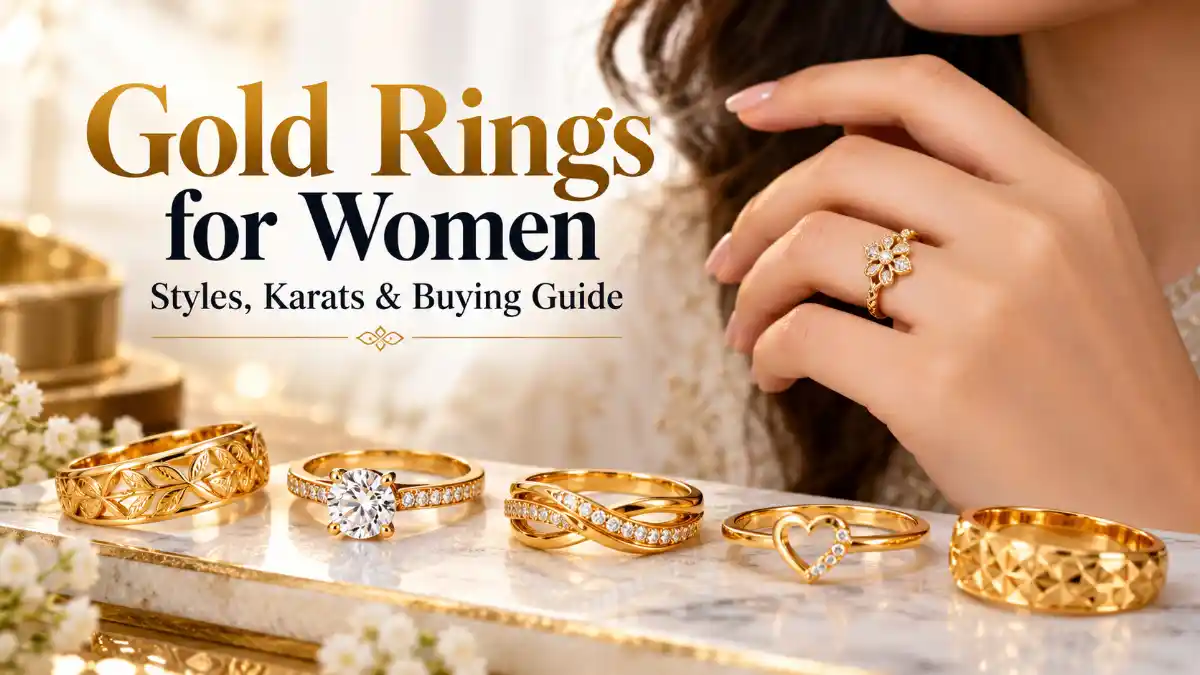
Shopping for a gold ring gets complicated surprisingly fast. Two rings can look nearly identical online but differ in karat, gold content, construction, stone quality, maintenance needs, and price.
The easiest way to narrow the choices is to start with how you’ll actually wear the ring. A simple 14K yellow gold band may make sense for frequent wear, while an 18K gemstone ring might appeal to someone who prioritizes higher gold content and a more decorative look. White gold and rose gold introduce different colors and upkeep considerations, too.
This guide breaks down the styles, materials, sizing, pricing, and practical details worth checking before choosing gold rings for women.
Gold Rings for Women at a Glance
If you don’t know where to start, decide what you want the ring to do first. A ring worn to work every day has different practical requirements from one reserved for weddings, parties, or special occasions.
| What you’re looking for | Good starting point | What to check |
| Everyday ring | Simple 14K or 18K design | Comfort, profile, setting |
| Classic look | Yellow gold | Karat and construction |
| Cool-toned look | White gold | Rhodium-plating upkeep |
| Warm modern look | Rose gold | Alloy composition |
| Statement piece | Wider or stone-set design | Comfort and snagging |
| Gift | Versatile, simple design | Size and return policy |
| Diamond/gemstone ring | Secure stone setting | Stone details and setting |
Read More: Gold Rings for Women
Gold’s durability changes with its purity and alloy composition. Pure 24K gold is relatively soft and more prone to scratches and dents, while alloyed 14K and 18K gold are better suited to many everyday rings.
The practical buying sequence is simple: use → karat → color → design → size → seller and product checks.
Popular Gold Ring Styles for Women
Ring style isn’t only about appearance. Width, profile, stones, and detailing affect comfort, maintenance, and how practical a ring is for regular wear.
Minimalist and Simple Gold Rings
Minimalist rings usually rely on slim bands, subtle curves, small motifs, or clean geometric shapes rather than large stones or elaborate settings.
Their low-key appearance makes them easy to wear alone or alongside other jewelry. A smooth, lower-profile design can also be practical for frequent wear because there’s less to catch on clothing, gloves, or other objects.
Don’t assume every thin ring is equally durable, though. Look at the actual construction and thickness rather than judging from a close-up product photo.
Classic Gold Bands
A gold band can be polished, brushed, hammered, textured, rounded, flat, narrow, or wide. Small differences in width and profile can dramatically change how it feels on your hand.
Width is particularly important when buying online. Wider bands generally fit more snugly than narrow ones, and GIA recommends additional sizing consideration for wide shanks.
If you’re torn between two widths, try comparable rings in person before ordering whenever possible.
Stackable Gold Rings
Stackable rings let you combine different textures, widths, shapes, and gold colors rather than committing to one larger design.
The catch is fit. Three narrow rings worn together effectively create a wider section around your finger. Don’t size each ring in isolation without considering how the full stack will feel.
A simple stack might combine a plain band, a textured ring, and one delicate stone-set piece. Keeping one element visually dominant often prevents the combination from looking overly busy.
Diamond and Gemstone Gold Rings
Diamonds, birthstones, and colored gemstones can turn a simple gold setting into the focal point of the ring.
Once stones are involved, however, there is more to evaluate than the gold itself. Check the setting style, whether the gemstone is natural or lab-created where relevant, disclosed treatments, and how exposed the stone is during everyday wear.
The FTC notes that natural, laboratory-created, and imitation gemstones are distinct categories and that shoppers should pay attention to how sellers describe them.
Also remember that karat measures gold purity, while carat is a unit used for gemstone weight. They sound alike but describe different things.
Statement and Cocktail Rings
Statement rings are designed to be noticed. Expect larger motifs, sculptural forms, wide surfaces, clusters, or prominent stones.
Before choosing one for frequent wear, look at it from the side as well as from the top. A tall setting can catch on sweaters or hair and may be inconvenient if you regularly wear gloves or work extensively with your hands.
For occasional wear, those trade-offs may matter much less.
Vintage-Inspired Gold Rings
Milgrain-like detailing, engraving, filigree-inspired work, geometric patterns, and ornate stone settings can create a vintage aesthetic without requiring you to buy an antique.
Pay attention to terminology here. A newly manufactured ring with an Art Deco-inspired pattern is vintage-inspired, not necessarily vintage or antique.
Intricate details can also create more small spaces where lotion and dirt collect, so consider maintenance alongside appearance.
Signet and Personalized Rings
Signet rings range from traditional flat-faced designs to contemporary versions with initials, dates, symbols, birthstones, or engraving.
They work particularly well as meaningful gifts because the personalization can make a relatively simple design feel individual.
Check the retailer’s policy before engraving anything. Personalized jewelry may have different return or exchange conditions from an unmodified ring.
Read More: Gold Rings for Women
10K vs. 14K vs. 18K Gold Rings
The number before the “K” tells you how much of the alloy is gold. Pure gold is 24K, and lower karats contain gold mixed with other metals.
The FTC explains, for example, that 18K consists of 18 parts gold and six parts other metal, while 14K contains 14 parts gold and 10 parts other metal.
What Does Gold Karat Mean?
Here’s the basic math:
- 24K: essentially pure gold
- 18K: 75% gold
- 14K: about 58.3% gold
- 10K: about 41.7% gold
Higher karat means a higher proportion of gold. It does not automatically mean it’s the right choice for every ring.
Pure gold is soft. Mixing it with other metals changes properties such as hardness and color, which is why jewelry designed for regular wear is commonly made from gold alloys.
Which Karat Is Better for Everyday Wear?
For many shoppers, 14K sits in a practical middle ground: it contains more alloying metal than 18K, while still being a gold alloy widely used in fine jewelry.
An 18K ring contains substantially more gold and generally has a richer gold appearance, particularly in yellow gold, but its higher gold content also means the alloy is comparatively softer.
GIA identifies both 14K and 18K as suitable choices for everyday rings, in contrast with softer 24K gold.
Your routine matters as much as the number stamped inside the ring. Someone wearing a ring occasionally has different durability concerns from someone who rarely takes it off.
Karat Comparison Table
| Factor | 10K | 14K | 18K |
| Approx. gold content | 41.7% | 58.3% | 75% |
| Relative gold content | Lowest | Middle | Highest |
| Relative hardness | Higher | Balanced | Lower |
| Yellow-gold color | Less intense | Moderate | Richer |
| Price influence | Generally lower | Middle | Generally higher |
| Consider for | Budget and durability | Everyday versatility | Higher gold content |
Read More: Gold Rings for Women
These are broad comparisons, not a pricing formula. A heavier 14K ring can cost more than a lightweight 18K ring, and craftsmanship, gemstones, brand, and design complexity also influence retail price.
Yellow Gold vs. White Gold vs. Rose Gold
Color doesn’t tell you purity. A ring can be 14K yellow gold, and another can be 14K white gold; both contain the same proportion of gold, but their alloy compositions and appearance differ.
Yellow Gold
Yellow gold keeps the warm appearance most people immediately associate with gold. Alloying metals such as copper, silver, and zinc can be used to alter its properties while retaining its yellow appearance.
It’s particularly easy to pair with other traditional yellow-gold jewelry and doesn’t have the rhodium-plating maintenance commonly associated with white gold.
White Gold
White gold is gold alloyed with lighter-colored metals, and many white-gold rings receive a rhodium coating that creates a brighter white finish.
That finish isn’t necessarily permanent. As rhodium wears, the underlying metal can begin to show a warmer tone, so replating may eventually be needed.
If you have a known nickel sensitivity, ask what metals are present in the alloy rather than assuming every white-gold ring has the same composition.
Rose Gold
Rose gold gets its pink or reddish tone primarily from copper in the alloy. Different formulations can produce anything from a subtle blush to a stronger rosy color.
It pairs naturally with warm-toned jewelry but doesn’t need to be reserved for a particular skin tone. Color matching is a style preference, not a purchasing rule.
People with metal sensitivities should still ask about the alloy composition.
Which Gold Color Should You Choose?
| Factor | Yellow Gold | White Gold | Rose Gold |
| Appearance | Warm, classic | Bright, cool-toned | Pink, warm |
| Routine maintenance | Relatively simple | May require rhodium replating | Relatively simple |
| Easy pairing | Yellow-gold jewelry | White metals | Warm/rose metals |
| Gemstone effect | Warm backdrop | Bright neutral backdrop | Warm contrasting backdrop |
| Sensitivity consideration | Check alloy metals | Check for nickel in particular | Check copper sensitivity |
Read More: Gold Rings for Women
Choose the color you’ll actually enjoy wearing. Maintenance and alloy sensitivity are more useful decision factors than rigid rules about which shade supposedly matches your complexion.
Solid Gold vs. Gold-Plated, Gold-Filled and Vermeil Rings
This terminology matters because two listings can both contain the word “gold” while describing very different constructions.
What Does “Solid Gold” Actually Mean?
“Solid gold” doesn’t mean 24K.
According to FTC consumer guidance, the term means the item isn’t hollow. A separate karat mark—such as 14K or 18K—indicates how much gold the alloy contains.
So a solid 14K gold ring can correctly be called solid gold even though the alloy isn’t pure gold.
What Is Gold-Plated?
A gold-plated ring has gold applied over another metal.
Because the gold is a surface layer rather than the material throughout the piece, that layer can eventually wear away. How quickly that happens depends on factors including plating thickness and how the jewelry is worn.
What Is Gold-Filled?
Gold-filled jewelry isn’t the same thing as solid gold, but it also shouldn’t be casually equated with ordinary electroplating.
FTC guidance describes “gold filled,” “gold overlay,” and “rolled gold plate” as products with a layer of at least 10K gold mechanically applied to a base metal, with specific marking requirements applying to these descriptions.
Always read the full product description rather than relying on the word “gold” in the title.
What Is Gold Vermeil?
Vermeil is a type of gold-plated product with sterling silver as its base, according to FTC consumer guidance.
That distinguishes it from gold plating over an unspecified base metal, but it still isn’t the same construction as a solid gold ring.
| Construction | Where the gold is | Wear consideration | Relative price tendency | Consider if |
| Solid gold alloy | Throughout the piece | Can scratch; no plating layer to wear through | Higher | You want fine jewelry for long-term use |
| Gold-filled | Mechanically applied gold layer over base metal | Surface eventually wears with enough use | Mid-range | You want more gold coverage than basic plating without solid-gold pricing |
| Gold-plated | Thin gold surface over another metal | Plating can wear | Lower | Budget/style is the priority |
| Vermeil | Gold coating over sterling silver | Coating can wear | Usually below solid gold | You prefer sterling silver beneath the gold |
Read More: Gold Rings for Women
Actual prices vary widely by design, thickness, stones, seller, and workmanship, so these relative categories aren’t guarantees.
How to Choose a Gold Ring for Everyday Wear
A daily ring needs to work with your hands, not only your wardrobe.
Match the Ring to Your Routine
If most of your day involves office work, you may be comfortable with a moderately raised stone setting. If you garden, work with equipment, exercise frequently, or do other hands-on activities, a smooth low-profile ring may be less intrusive.
This doesn’t mean you need an indestructible ring. It means you should be realistic about when you’ll remove it.
Check the Ring’s Profile
Before buying, look for:
- raised stones or settings
- sharp or protruding details
- smooth versus angular edges
- delicate openwork
- overall band thickness
- exposed stone edges
- how securely stones appear to be set
Product photos taken only from directly above can hide a surprisingly tall setting. Look for side-profile images.
Consider Maintenance Before Buying
Maintenance is part of ownership.
A plain yellow-gold band is relatively straightforward. White gold may eventually need rhodium replating. A ring with numerous small stones introduces settings that may need periodic inspection.
Choose the maintenance level you’re comfortable with rather than discovering it after the purchase.
Think About Metal Sensitivities
Gold jewelry shouldn’t automatically be described as hypoallergenic because gold alloys contain other metals.
White gold, for example, may contain nickel or palladium depending on the alloy. GIA specifically notes nickel as a potential concern for people with sensitivities.
If you’ve reacted to jewelry before, ask the seller for alloy information.
Daily-Wear Suitability Checklist
- □ Is the ring comfortable when you close your hand?
- □ Does anything catch on clothing?
- □ Is the setting unusually high?
- □ Are the edges smooth?
- □ Is the karat appropriate for how you’ll use it?
- □ Are there exposed or delicate stones?
- □ Do you understand the maintenance requirements?
- □ Do you know what’s in the alloy if you have metal sensitivities?
Read More: Gold Rings for Women
How Much Do Gold Rings for Women Cost?
There isn’t one useful fixed price for a gold ring. Gold prices change, and retail jewelry pricing involves much more than the raw metal.
What Determines a Gold Ring’s Price?
Important factors include:
karat + gold weight + prevailing gold value + craftsmanship + design complexity + gemstones + brand/retailer factors
A ring with more gold by weight generally contains more gold value, but that doesn’t tell you the entire retail price.
Hand finishing, intricate settings, diamonds, gemstones, custom work, and branding can all add cost.
Why Two Similar Rings Can Have Different Prices
Imagine two rings that look roughly the same size in a photograph.
Ring A is a heavier 14K plain band.
Ring B is a lighter 18K band with intricate detailing.
Ring B has a greater percentage of gold, but Ring A may contain more metal overall. Ring B may also require considerably more labor.
That’s why judging value from appearance or karat alone doesn’t work.
How to Compare Prices Fairly
When comparing two rings, check them in this order:
Karat → weight → construction → stones → craftsmanship → warranty/service → return policy → total price
If a retailer doesn’t provide information you consider important, ask before buying.
A comparison worksheet is more useful than a simple raw-gold calculator because the retail value of finished jewelry isn’t just the melt value of its gold.
How to Find Your Ring Size
Getting the design right doesn’t help much if the ring doesn’t fit.
How to Measure Your Finger at Home
For an initial estimate:
- Use a reliable printable U.S. ring-sizing guide or an actual ring-sizing tool.
- Measure the finger on which you’ll wear the ring.
- Follow the tool’s printing or calibration instructions exactly.
- Make sure the fit can pass over your knuckle without being excessively loose at the base.
- Repeat the measurement rather than trusting one attempt.
For an expensive ring or a difficult-to-resize design, professional sizing by a jeweler is the safer option.
Measure a Ring You Already Own
If you already have a ring that fits the correct finger, measure its inside diameter, not its outside edge.
The ring should be round for diameter-based sizing to be useful. GIA’s professional sizing guidance likewise uses internal measurements when matching rings to standardized sizes.
When Should You Measure?
Your finger doesn’t stay the same size all day.
Heat can make fingers swell, while cold can make them shrink. Humidity, altitude, and time of day can also affect fit.
Measure more than once under normal conditions rather than sizing immediately after unusually cold weather, strenuous exercise, or significant swelling.
And remember: a wide band may need different sizing consideration because it generally fits more snugly.
What If You’re Buying a Ring as a Gift?
You have a few discreet options:
- temporarily borrow a ring she wears on the correct finger
- ask someone close to her who may know
- compare the inside diameter of an existing ring
- choose a seller with a workable exchange/resizing policy
Don’t assume that a ring worn on another finger—or on the opposite hand—provides an exact size.
If you’re uncertain, avoid a highly customized piece until you’ve confirmed what happens if the size is wrong.
How to Check a Gold Ring Before You Buy
A beautiful product photo doesn’t tell you everything you need to know.
Check the Karat Mark
Look for the disclosed karat, such as 10K, 14K, or 18K.
The mark tells you the proportion of gold in the alloy. It shouldn’t be confused with the carat weight used for gemstones.
Look for Who Stands Behind the Mark
FTC consumer guidance advises shoppers to look near a karat quality mark for the name or U.S.-registered trademark of the company responsible for it.
This is a useful check that’s easy to overlook when attention is focused on the design.
Read the Product Description Carefully
Don’t stop at the product title.
Look for clear disclosures about whether the ring is:
- solid gold
- hollow
- gold-plated
- gold-filled
- vermeil
For stone-set jewelry, also check whether stones are natural, laboratory-created, or imitation and whether relevant treatments are disclosed.
Research the Seller
For a substantial purchase, look beyond star ratings.
Search the seller’s name alongside terms such as “reviews” or “complaints,” check how long the business has been operating where that information is available, and make sure there is a clear way to contact it.
The FTC recommends researching jewelry sellers and not relying solely on what appears online or on social media.
Read the Return, Warranty, and Resizing Policies
Check these policies before payment, not when something goes wrong.
Find out:
- how long the return window lasts
- whether return shipping or restocking fees apply
- whether worn items can be returned
- whether personalized pieces are excluded
- whether resizing is included or charged separately
- what the warranty actually covers
FTC consumer guidance specifically recommends finding a jewelry seller’s refund and return policies and getting them in writing.
Before-You-Buy Checklist
- □ Karat confirmed
- □ Solid/plated/filled/vermeil construction confirmed
- □ Gold weight checked if provided
- □ Correct ring size established
- □ Gemstone details understood
- □ Seller/mark identification checked
- □ Total price understood
- □ Return window read
- □ Warranty read
- □ Resizing policy checked
Can a Gold Ring Be Resized?
Many gold rings can be resized, but “gold” alone doesn’t determine whether resizing will be easy.
Rings That Are Generally Easier to Resize
A conventional plain band without stones running around the entire circumference is often more straightforward for a jeweler to alter.
The amount it can be changed still depends on the ring’s dimensions, construction, alloy, and design.
Don’t treat “resizable” as meaning “can be changed to any size.”
Designs That May Be More Difficult
Resizing can become more complicated with:
- eternity-style settings
- stones extending around most or all of the band
- intricate patterns
- unusual or asymmetrical shapes
- extensive engraving
- very wide bands
Changing the circumference may disturb stone spacing, patterns, or the intended shape.
If you’re considering an expensive ring, ask the jeweler how many sizes it can realistically be altered before you buy it.
Choosing a Gold Ring by Occasion
The same ring doesn’t have to work for every situation.
Everyday and Work
Prioritize comfort, manageable width, smooth edges, and a profile that suits your routine.
A subtle band or low-profile stone design is easier to integrate into daily life than a ring you constantly worry about knocking against things.
Engagement and Wedding
Think beyond the proposal or wedding day.
Consider how the engagement ring will sit beside a wedding band, whether exposed stones rub against neighboring jewelry, how secure the setting is, and whether the design can be resized later.
Long-term comfort matters more here than short-term visual impact.
Birthday, Anniversary and Graduation Gifts
Personalization can work particularly well for milestone gifts.
Initials, meaningful dates, birthstones, engraving, or a motif connected to the recipient can make a simple ring feel more intentional.
Just verify size and return restrictions before personalizing it.
Parties and Special Events
This is where statement rings make more sense.
Larger gemstones, wider bands, sculptural designs, and unusual silhouettes can provide visual impact without needing to be practical enough for everyday wear.
The Gold Ring Buying Decisions Most Guides Miss
The most useful questions aren’t always the ones shown in a retailer’s filters.
Don’t Compare Rings by Karat Alone
An 18K ring contains a higher proportion of gold than a 14K ring. That doesn’t automatically tell you which ring is heavier, more intricate, better made, or more expensive.
Compare the complete piece.
Higher Karat Isn’t Automatically Better for Daily Wear
Higher karat means more gold—not automatically better durability.
Because pure gold is soft, alloying gold with other metals can increase its hardness. That’s one reason 14K and 18K are commonly considered practical choices for rings worn regularly.
Wider Bands Can Change the Fit
If you know your size from a delicate ring, don’t automatically order a very wide band in the same size.
GIA notes that wide shanks tend to fit more snugly and require additional sizing consideration.
Think About Future Resizing Before Personalization
Engraving the entire circumference or adding an intricate pattern can make later alteration more complicated.
If the ring is meant to last decades, ask what can be changed later before adding permanent customization.
Account for Long-Term Maintenance
Compare three rings:
A plain yellow-gold band may mostly need routine cleaning and occasional polishing.
A white-gold ring may eventually need rhodium replating.
A stone-set ring may need both cleaning and periodic inspection of its setting.
The purchase price isn’t the only practical difference.
Know Exactly What “Gold” You’re Buying
“Gold ring” is not a precise construction description.
Solid gold alloy, hollow gold, gold-filled, gold-plated, and vermeil products can look similar in photographs but differ materially in construction.
Read the specifications before comparing prices.
Common Mistakes to Avoid When Buying a Gold Ring
Most poor buying decisions happen because one detail gets too much attention.
Choosing by appearance alone. A beautiful ring can still be uncomfortable, difficult to maintain, or unsuitable for your routine.
Assuming “gold” means solid gold. Check the construction.
Confusing karat and carat. Karat describes gold purity; carat measures gemstone weight.
Ignoring the alloy. This matters particularly if you have known metal sensitivities.
Guessing the ring size. Small differences matter, especially with wider bands.
Forgetting band width. Your usual size may feel different in a wide design.
Ignoring maintenance. White gold and intricate stone settings may need more upkeep than a simple band.
Overlooking the setting. A stone’s beauty isn’t much comfort if the setting doesn’t suit how you use your hands.
Assuming every ring is easily resizable. Confirm before buying.
Skipping written policies. Return, personalization, warranty, and resizing rules can matter as much as the product description.
How to Clean and Care for Gold Rings
Good care doesn’t need to be complicated, but the correct method depends on what’s set in the gold.
Everyday Care
Remove fine jewelry before using strong household cleaners or entering chlorinated pools. GIA notes that chemicals can damage precious metals and certain gemstones, and chlorine bleach can damage gold alloys.
Store rings separately or in padded compartments so harder stones and neighboring pieces don’t continually rub against them.
Cleaning at Home
For many pieces, gentle cleaning is the safest starting point. GIA recommends warm water, mild dish soap, and a soft brush for many colored gemstones, while noting that some materials need special care.
Avoid toothpaste and abrasive household cleaners. They can scratch metals and some gemstones.
Don’t automatically put a gemstone ring in an ultrasonic cleaner either. Some stones, treatments, and fragile settings can be damaged, and vibration can loosen stones.
When to Visit a Jeweler
Professional attention makes sense when:
- a stone moves in its setting
- a prong looks bent or damaged
- the band has changed shape
- the ring needs resizing
- scratches or damage are significant
- you’re unsure how a gemstone should be cleaned
A professional can inspect the setting before cleaning methods that might be risky at home.
Does White Gold Need Different Care?
Potentially, yes.
White gold is commonly rhodium plated to create its bright white finish. That plating gradually wears, so the ring may need occasional replating to restore its original appearance.
How often depends on the ring and how it’s worn; there isn’t one universal schedule that applies to everyone.
Internal-Link Opportunities
If your site has deeper guides on these subjects, useful contextual anchors include:
- how to measure ring size at home
- 14K vs 18K gold
- yellow gold vs white gold
- how to clean gold jewelry
- types of rings for women
- gold-plated vs solid gold
- engagement ring buying guide
- how to stack rings
Use these only where the linked page genuinely answers the next question. Eight links aren’t automatically better than three useful ones.
Conclusion: Choose the Ring Around How You’ll Actually Wear It
Start with purpose and budget, then narrow the choice by karat, gold color, design, and size. Once you have a few candidates, compare what’s less obvious in the photos: construction, setting, maintenance, resizing options, and the seller’s written policies.
A ring with the highest gold content or biggest stone isn’t automatically the most practical choice. The right one is the piece that fits your style, hand, routine, and budget without asking you to overlook important trade-offs.
Before paying, run through the buying checklist once more. A few minutes spent checking the details can prevent a much more expensive mistake later.
Frequently Asked Questions
Both can work well for everyday jewelry. GIA considers 14K and 18K suitable for regular wear, while 14K’s larger proportion of alloying metals generally gives it an edge in hardness. Choose based on durability needs, gold content, appearance, and budget rather than assuming one is universally better.
A 14K gold alloy contains 14 parts gold out of 24, or about 58.3% gold. The remaining portion consists of other metals used to alter properties such as hardness and color.
Read the markings and product description carefully. A solid-gold ring should carry an appropriate karat designation, while plated products should be described according to their construction. The FTC also advises checking for the name or U.S.-registered trademark of the company standing behind the karat mark.
Both use gold over another metal rather than a gold alloy throughout. FTC guidance describes gold-filled jewelry as using a mechanically applied layer of at least 10K gold under specified marking rules, while gold plating can be applied through electroplating and other processes.
Many white-gold rings are coated with rhodium to create a bright white finish. Because that coating can gradually wear, occasional replating may be needed. How soon depends on the piece and how frequently it’s worn.
Yes, many gold alloys are suitable for regular wear. GIA identifies 14K and 18K as practical everyday options, while softer 24K gold is more susceptible to scratching and denting. Your ring’s design and your daily activities also affect how practical it is.
It should feel secure at the base of your finger while still passing over the knuckle without excessive force. Keep band width in mind: wider rings usually feel more snug than narrow rings and may require different sizing considerations.
No. Many conventional gold bands can be altered, but eternity settings, intricate patterns, extensive stone settings, unusual shapes, and some personalized designs can make resizing difficult. Ask the jeweler about the specific design before purchasing.
Confirm the karat, construction, size, weight if provided, stone details, seller identity, total price, return window, warranty, and resizing policy. The FTC recommends researching jewelry sellers and obtaining refund and return policies in writing.
If possible, borrow a ring she already wears on the intended finger and have its inside dimensions checked. A trusted friend or family member may also know her size. If you’re still unsure, prioritize a design that can potentially be resized and a retailer with a clear exchange policy rather than guessing and immediately adding non-returnable personalization.