
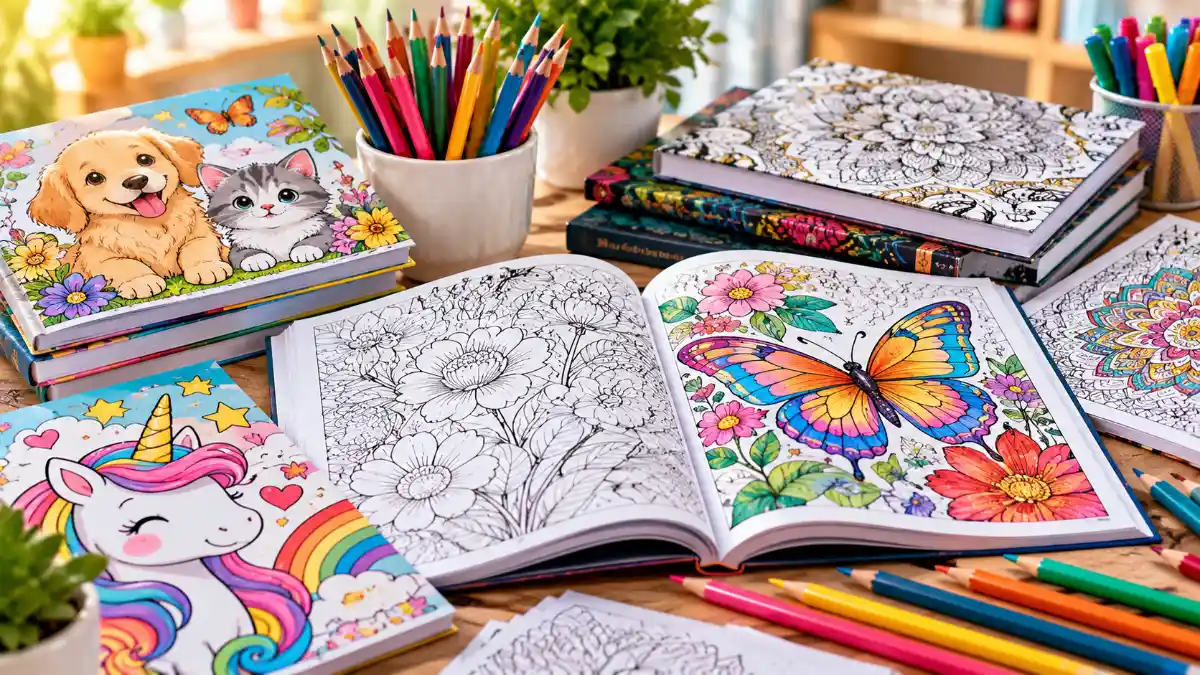
Coloring books contain outlined pictures and patterns that children or adults fill in using crayons, colored pencils, markers, or other art supplies. The best choice depends on the user’s age, interests, preferred tools, and comfort with detailed designs. Young children often enjoy big shapes and familiar subjects, while older kids and adults may prefer animals, mandalas, landscapes, or intricate scenes.
What Are Coloring Books?
Coloring books are collections of black-and-white illustrations intended for adding color. Some feature simple outlines; others offer elaborate scenes with hundreds of small spaces. Color-by-number editions assign particular colors to marked areas, while open-ended pages let you decide everything.
Most are bound paper books, although downloadable coloring pages are another option.
Who Are Coloring Books Made For?
These activity books are available for preschoolers, school-age children, teenagers, adults, and older people. Younger children often find broad spaces and thick outlines easier to manage. Older children may enjoy smaller details, recognizable characters, or pages that combine coloring with puzzles.
Adult coloring books range from cozy illustrations to highly detailed architecture and botanical drawings. Match the artwork to the person’s interests and comfort, not just the age printed on the cover.
What Are the Main Types of Coloring Books?
Common choices include animal and nature collections, cartoons, educational themes, geometric patterns, mandalas, and color-by-number books. Educational editions sometimes combine pictures with letters, numbers, maps, or vocabulary. Activity books may add mazes, tracing, or matching games.
If you’re buying online, inspect sample interior pages instead of relying on the cover. The inside illustrations reveal whether the book is genuinely easy, intricate, or somewhere between.
Are Coloring Books Good for Kids?
Coloring gives children a chance to use their hands purposefully while looking closely at shapes and boundaries. Holding a crayon, choosing colors, and experimenting with pressure can be part of everyday creative play.
The American Academy of Pediatrics encourages preschoolers to have access to materials such as crayons, markers, paint, and paper for creative play. Its preschool creativity and play guidance emphasizes experimentation, not perfect results.
Coloring alone isn’t a proven shortcut to developmental milestones. Let children enjoy the process rather than insisting they stay inside every line.
Do Adult Coloring Books Help With Relaxation?
Research has found short-term anxiety improvements in certain circumstances, but results differ by setting and study design.
In a 2020 randomized trial involving 53 emergency-department patients, participants assigned a coloring activity reported larger reductions in anxiety after two hours than those receiving a comparison activity. The adult coloring randomized trial describes that specific clinical setting.
Another experiment found no anxiety improvement from unguided mandala coloring in its student sample, although guided coloring showed a benefit in a separate experiment. The mindfulness-guided coloring research illustrates why broad claims should be avoided. Coloring can be enjoyable self-care, not a substitute for mental-health treatment.
How Do You Choose the Right Coloring Book?
Start with the recipient’s favorite subjects. A dinosaur enthusiast might ignore a book of generic patterns but eagerly color every prehistoric scene. Next, judge difficulty: large areas suit beginners, while tightly packed designs suit people who enjoy careful detail.
Check page count, whether printing is single-sided, and whether pages are perforated. For markers, blank backs or separate sheets help avoid ruining another design. Books that open flat are easier to use near the spine.
What Coloring Tools Work Best?
Crayons cover large spaces and are familiar to children. Colored pencils offer control, gentle blending, and access to fine details. Markers give vivid coverage, but some inks bleed through thin paper. Gel pens are useful for accents rather than large backgrounds.
Try pencils for complex illustrations and crayons or tested markers for bold designs. For children, follow the manufacturer’s age guidance and choose materials intended for their age group.
What Should You Look for in Paper and Printing Quality?
Paper makes a noticeable difference. Lightweight sheets may buckle when wet or show marks from the reverse side. Thicker stock can handle more layering, though alcohol-based markers may still bleed through it.
Look for crisp outlines, generous margins, and a binding that doesn’t hide part of the picture. Single-sided designs are helpful when using markers; a spare sheet behind the page provides extra protection.
Printed vs. Printable Coloring Books: Which Is Better?
Printed editions are ready to use, easy to pack, and keep illustrations together. They make practical gifts and work well when you don’t want to print pages at home.
Printable coloring pages let you choose individual designs and different paper. You can make copies for a group if the download’s license permits it. However, paper and ink cost money, and some downloadable artwork is licensed for personal use only. Choose printed books for convenience or printable sets for flexibility.
How Can Beginners Get Better Results?
Start with a simple picture and a handful of colors. With pencils, apply light pressure and build layers gradually. Try making edges slightly darker than the center of a shape for a subtle shaded effect.
Put scrap paper beneath a page before testing unfamiliar markers. If tiny spaces feel tedious, switch to a bold-outline design. Enjoyment is a better goal than making every picture look professional.
Are There Any Downsides or Limitations?
Intricate pages can become tiring, particularly for younger children or anyone with vision or hand-mobility difficulties. Choose an easier design or take breaks when needed. Supervise young children and avoid materials that pose choking or other age-related hazards.
Be skeptical of products promising to cure anxiety, improve intelligence, or deliver guaranteed developmental benefits. Coloring is an accessible hobby, but individual experiences vary.
How Can You Make Coloring More Enjoyable?
Set up a comfortable spot with good lighting and keep a few favorite tools nearby. Try changing themes with the seasons, coloring alongside a friend, or pairing a session with music or an audiobook.
Finished artwork can become greeting cards, bookmarks, or wall decorations. A book should invite creativity, not become another chore.
Conclusion
The right coloring books match the person’s interests, skill level, and preferred materials. Look beyond the cover: examine sample illustrations, paper, and page layout. Whether you choose a playful children’s edition or detailed adult designs, the simplest test is whether the pages make you want to color.
- Read more: Coloring Books
Frequently Asked Questions
Are coloring books only for children?
No. Adult editions include intricate art, cozy scenes, and large-print designs. The activity can suit almost any age.
When can toddlers start coloring?
Children may begin scribbling during toddlerhood. Choose age-appropriate crayons and paper, supervise closely, and don’t expect precise coloring.
Do coloring books really reduce anxiety?
Some studies report short-term reductions in particular groups, while others find mixed results. Coloring is not a clinical treatment.
Which coloring books are best for beginners?
Choose clear outlines, large spaces, and a subject you enjoy. Bold-and-easy or color-by-number designs are approachable starting points.
Should I use markers or colored pencils?
Pencils provide precision and blending. Markers offer brighter coverage but may bleed through, especially on thin pages.
What is a mandala coloring book?
It’s a collection of usually circular, symmetrical patterns. Some are simple; others have many tiny sections.
Can coloring books support learning?
Educational pages can introduce letters, numbers, or other topics. Their usefulness depends on accurate content and age-appropriate interaction.
Are printable coloring pages cheaper?
Not necessarily. Compare the download price and printing expenses with a ready-made book, especially for frequent use.
Can you use watercolor in a coloring book?
Only when the paper tolerates water. Ordinary thin sheets may warp, wrinkle, or tear when wet.