
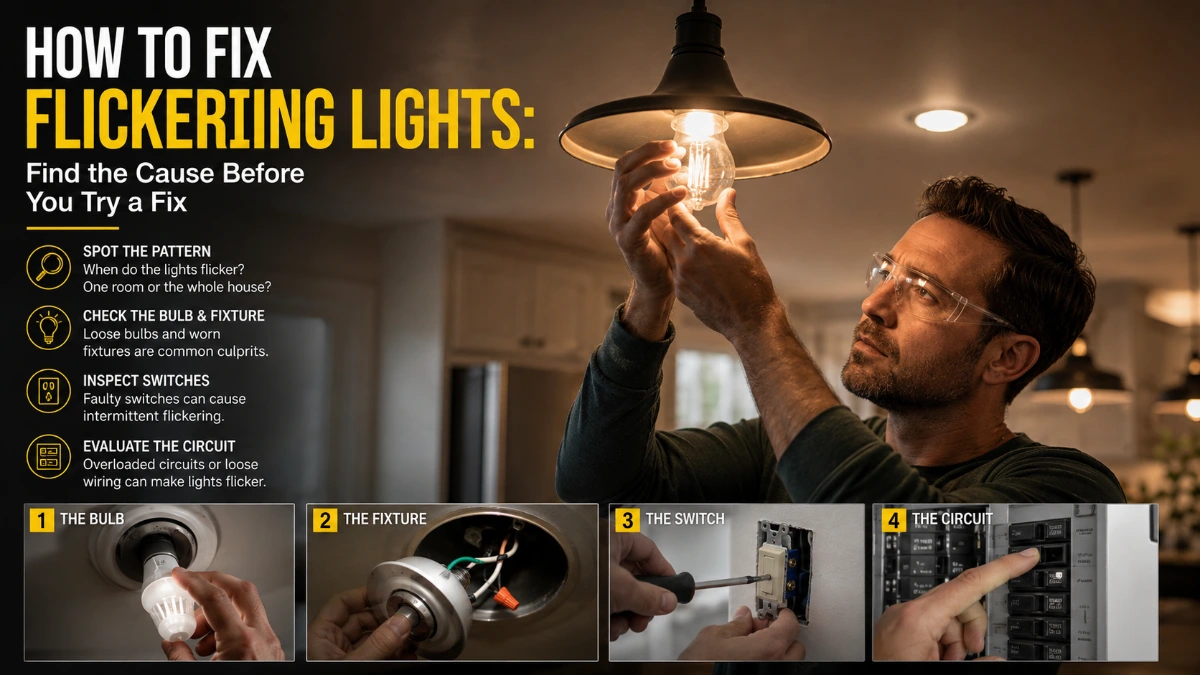
How to Fix Flickering Lights: Safe Troubleshooting Steps
Most flickering starts with a bulb, socket contact, or LED-dimmer mismatch. But lights that flicker across rooms — especially alongside heat, burning smells, buzzing, sparks, or frequent breaker trips — need professional attention, not a DIY repair.
First, choose the safe path
The safest approach to how to fix flickering lights depends on the pattern you see.
| If this is happening | Your next step |
| One bulb flickers | Turn it off, let it cool, then tighten or replace it |
| Flicker began after installing an LED bulb | Check whether the bulb is dimmable and compatible with the dimmer |
| A replacement bulb still flickers in one fixture | Stop at the bulb-swap test and call an electrician |
| Multiple lights or rooms flicker | Arrange electrician assessment promptly |
| Flicker happens in wind or after storm damage | Call the power company; do not touch service equipment |
| Flicker comes with heat, buzzing, smells, sparks, or breaker trips | Stop using the affected circuit and contact an electrician |
The U.S. Consumer Product Safety Commission lists flickering or dimming lights, sizzling or buzzing, overheated-plastic odours, sparks, hot outlet covers, and frequently resetting breakers as electrical-system hazard signs.
What you can safely check
For most households, how to fix flickering lights should stop at bulb-level checks and product compatibility. Do not remove a switch cover, open a fixture, access a junction box, touch exposed wiring, or work in a consumer unit/electrical panel unless you are qualified and permitted to do so.
Tighten the bulb
- Switch the light off.
- Let the bulb cool.
- Tighten it gently until snug; never force it.
- Turn the light back on and watch for recurring flicker.
Replace bulbs that have cracked glass, damaged bases, or visible scorching. Do not use a bulb above the fixture’s stated maximum wattage; CPSC warns that excessive wattage can create an overheating hazard.
Use a bulb-swap test
If tightening does not work, fit a known-good, compatible bulb in the affected fixture. Then test the suspect bulb in another suitable fixture.
- Flicker follows the bulb: replace the bulb.
- A known-good bulb flickers only in the original fixture: the problem is likely fixture-side, so arrange an electrician.
- Several lights flicker: skip more bulb testing and treat it as a wider electrical issue.
This is the practical DIY boundary in how to fix flickering lights: bulb replacement can identify a likely cause, but a socket, fixture, switch, driver, or wiring fault needs professional diagnosis.
Fix LED dimmer flicker
If the light flickers only when dimmed, how to fix flickering lights may involve the LED-and-dimmer pairing rather than the bulb alone.
- Confirm that the LED bulb is marked dimmable.
- Check that the dimmer is intended for LED loads.
- Find the bulb manufacturer’s or dimmer manufacturer’s compatibility list.
- Compare the exact bulb or luminaire model with the exact dimmer model.
- If the pairing is unlisted or unstable, ask an electrician to select and install a suitable dimmer.
Compatibility is model-specific. LEDVANCE publishes product-by-product dimmer lists and notes that LED/dimmer operation is not governed by one universal technical standard.
Treat warning signs seriously
Do not keep troubleshooting if flickering is paired with other symptoms. The Electrical Safety Foundation International identifies flickering or dimming lights, burning odours, discoloured switches, and warm outlets as signs that can indicate a serious wiring problem.
Stop using the affected circuit and call a licensed electrician when you notice:
- Warm, loose, damaged, or discoloured switches or outlets
- Buzzing, sizzling, crackling, a burning-plastic smell, sparks, or smoke
- Breakers that trip repeatedly or fuses that blow repeatedly
- A shock or tingling sensation from an appliance, switch, or outlet
- Flickering in more than one room or on more than one circuit
Renters should report these conditions promptly to their landlord or property manager. Do not open outlets, switches, or fixtures in a rental to investigate.
Know who to call
How to fix flickering lights may mean reporting the problem rather than repairing it. Use this decision rule:
- Call an electrician for a persistent fixture issue, a switch or outlet issue, a recurring circuit issue, or widespread indoor flickering.
- Call the power company when flicker occurs during wind or after storm damage and may involve the incoming service.
- Call emergency services for smoke, fire, downed lines, or immediate danger.
CPSC says that wind-related flickering can be caused by a bad contact at the connection between a home’s service-entrance cable and its service drop. It advises people not to touch the equipment or attempt repairs, and to contact the electric power company immediately.
Avoid these “fixes”
Do not force a non-dimmable LED bulb onto a dimmer circuit, repeatedly reset a breaker, install an over-wattage bulb, or rely on permanent extension-cord arrangements to bypass an electrical problem. These actions can leave the underlying issue unresolved; CPSC notes that hot outlet covers and frequently reset breakers are potential wiring-hazard signals.
Read also: How to Fix Flickering Lights: Diagnose the Pattern, Then Act Safely
Frequently Asked Questions
Can a loose bulb make a light flicker?
Yes. A loose bulb may not make consistent contact with its socket. With power off and the bulb cool, tighten it gently or replace it if damaged.
Why do LED bulbs flicker on a dimmer?
The bulb may be non-dimmable, the dimmer may not be designed for LED loads, or the exact bulb-and-dimmer models may be incompatible. Check the manufacturer’s compatibility list.
Is a flickering light an emergency?
A single flickering bulb may be a straightforward bulb or connection issue. Treat it as urgent when it occurs with heat, burning odours, buzzing, sparks, smoke, repeated breaker trips, or a widespread electrical problem.
Why do lights flicker in the wind?
It may indicate a poor contact at the utility-service connection. Stay away from service equipment and contact the power company immediately.
Can a renter replace a flickering bulb?
Usually, a renter can switch off a light and replace an ordinary bulb if permitted by the tenancy agreement. Persistent flickering or warning signs should go to the landlord or property manager.
Should I change the dimmer switch myself?
Only if you have the appropriate competence and local rules permit the work. Otherwise, use a licensed electrician, particularly when the cause of the flickering has not been confirmed.