
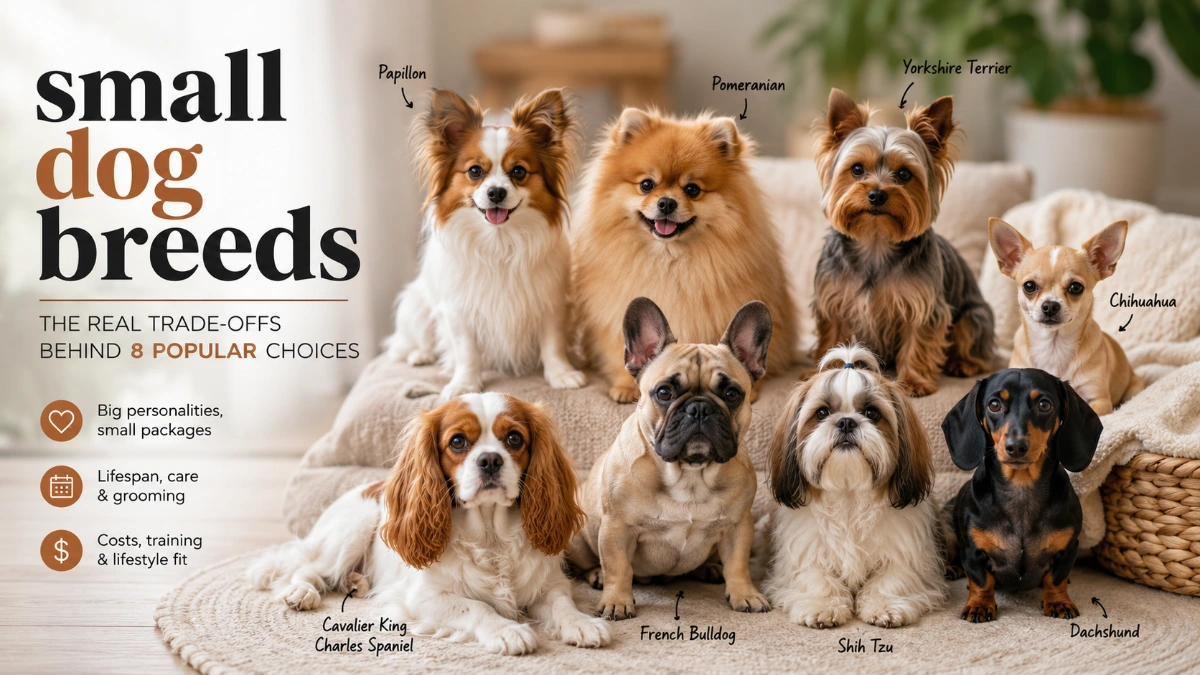
small dog breeds: 8 Honest Trade-Offs Before You Choose
A new owner once assumed a tiny, low-shedding dog would mean less work than a larger breed, only to discover that “low shedding” meant weekly professional grooming and a coat that matted without daily brushing. That gap between expectation and reality is the real story behind small dog breeds: every appealing trait comes with a corresponding cost, and the smartest shortlist is built by weighing both sides honestly.
Size tells you almost nothing about exercise needs, noise, trainability, or grooming demands. A dog can be small enough to fit in a bag and still need daily structured activity, consistent training, and a serious grooming budget.
Eight Breeds, Eight Different Trade-Offs
Rather than ranking these small dog breeds, the table below pairs each one’s appealing trait with the corresponding commitment it requires. Read both columns before assuming a breed is “easy.”
| Breed | The appeal | The trade-off |
| Chihuahua | Extremely small, devoted, alert companion | Needs careful handling, early socialisation, and calm, consistent training |
| Maltese | Elegant, affectionate, playful companion | Long coat requires regular, ongoing brushing to prevent matting |
| Miniature Schnauzer | Lively, engaged, comparatively low-shedding | Coat still needs routine clipping and grooming; energy needs daily outlets |
| Toy or Miniature Poodle | Trainable, athletic, lower-shedding coat | Intelligence requires real mental engagement; grooming is a recurring cost |
| Cavalier King Charles Spaniel | Gentle, sociable, deeply companionable | Breed-specific health research and screening should shape the decision |
| Dachshund | Curious, determined, distinctive character | Coat care varies by variety; veterinary guidance on lifelong care matters |
| Shih Tzu | Close, indoor-oriented, companion-focused | Regular grooming and brachycephalic health awareness are both necessary |
| Pug | Sociable, affectionate, people-focused | Flat-faced-dog breathing and health considerations must be central, not secondary |
Chihuahua: Small Body, Significant Presence
The American Kennel Club describes the Chihuahua as a tiny dog with a notably big personality, and that description captures both its appeal and its management needs. A dog this alert and this small requires gentle, deliberate handling to avoid injury and stress.
The trade-off is supervision, not difficulty. Children should never be left unsupervised with a Chihuahua, and adults should prevent situations where the dog feels cornered, dropped, or startled. This is a management requirement, not a criticism of the breed.
Maltese: Elegance With a Grooming Bill Attached
Maltese dogs are recognised for a striking, silky coat and an affectionate temperament that suits close companionship. The appeal is visual and emotional; the trade-off is almost entirely about time.
A long coat needs brushing several times a week to prevent tangles near the skin, while a shorter, practical clip reduces but does not eliminate this workload. Anyone comparing small dog breeds for a low-effort option should weigh this coat commitment carefully before choosing a Maltese.
Miniature Schnauzer and Poodle: The Low-Shedding Myth
Both breeds are frequently recommended because they shed comparatively little, but “low shedding” is often misread as “low maintenance.” In practice, a coat that does not shed loose hair around the house usually needs professional clipping and frequent brushing to prevent painful matting close to the skin.
There is a second trade-off beyond grooming: both breeds are genuinely active and mentally engaged dogs. A Miniature Schnauzer or Poodle chosen purely for its coat, without a plan for daily exercise and training, is likely to develop frustration-driven behaviours such as barking or restlessness.
Cavalier King Charles Spaniel: Affection Paired With Homework
The Cavalier’s gentle, people-oriented temperament makes it one of the more emotionally accessible small dog breeds for households wanting constant companionship. That accessibility comes with a responsibility most buyers underestimate: breed-relevant health research before purchase, not after.
Ask any breeder directly about the health of the puppy’s parents and what relevant screening has been carried out. A rescue organisation should be equally willing to share what it knows about a dog’s medical background. Sociability is not a substitute for due diligence.
Dachshund: Personality Built on a Distinctive Frame
Dachshunds combine a strong, curious personality with a body shape that is instantly recognisable. The trade-off here is informational rather than behavioural: coat type differs meaningfully between smooth, long-haired, and wire-haired varieties, so generic breed descriptions are less useful than variety-specific ones.
Because of the breed’s distinctive proportions, prospective owners should ask a veterinarian or a recognised breed-health organisation about appropriate lifelong care for the individual dog, rather than relying on general assumptions from breed popularity alone.
Shih Tzu and Pug: Where Appearance and Health Intersect Most Directly
Shih Tzus and Pugs sit at the centre of the most important trade-off among popular small dog breeds: companionship style versus body-shape-related health risk. The Kennel Club lists both breeds among commonly recognised brachycephalic types, noting that muzzle length and body shape vary between individuals and that some flat-faced dogs experience health problems affecting breathing, eyes, skin, or other functions.
This does not mean every Shih Tzu or Pug will develop these issues, but it does mean the trade-off deserves more attention than coat colour or size. Ask directly about the health and breathing of the puppy’s parents, review any available screening results, and treat loud breathing, persistent snoring while awake, snorting, or poor tolerance of ordinary activity as reasons to seek veterinary advice rather than as normal breed quirks.
Turning Trade-Offs Into a Decision
Once you understand what each breed actually costs in time, money, training, and welfare attention, the decision becomes a matching exercise rather than a popularity contest. Ask which trade-offs you can absorb comfortably and which ones would create ongoing strain.
For example, a household with a flexible schedule and grooming budget might comfortably manage a Poodle’s coat needs, while a household with less time might find that trade-off unsustainable even though the dog’s temperament fits perfectly. The right choice among small dog breeds is the one whose costs match your actual capacity, not your ideal self-image as an owner.
A Practical Six-Step Filter
Use this sequence to move from broad interest in small dog breeds to a responsible shortlist:
- List the trade-offs you can genuinely sustain: grooming time, exercise commitment, noise tolerance, budget, and household composition.
- Match two or three breeds, or individual rescue dogs, whose typical trade-offs align with that list.
- Read breed-specific health and welfare guidance from recognised veterinary or kennel organisations before contacting anyone.
- Meet adult dogs where possible and observe real behaviour around handling, rest, activity, and strangers.
- Ask breeders or rescues for health records, relevant screening results, and honest temperament history.
- Consult a veterinarian or a qualified behaviour professional before committing if health, behaviour, or household-safety questions remain.
A dog chosen for its trade-offs, not just its charm, is far more likely to thrive in your home for its entire life.
Frequently Asked Questions
There is no universally “easiest” breed. A good beginner match depends on which trade-offs, such as grooming time or training consistency, a first-time owner can realistically sustain.
Poodles and Miniature Schnauzers are commonly cited as lower-shedding options, but both require regular brushing and professional grooming, so the trade-off shifts from cleaning to coat maintenance rather than disappearing.
They can be, but apartment success depends on meeting daily exercise, enrichment, and noise-management needs rather than on size alone.
Not necessarily, but both are classified among commonly recognised brachycephalic breeds and can be affected by body-shape-related health issues. Prospective owners should research breed-specific health risks and seek veterinary advice for any individual dog.
Not reliably. Lower shedding does not guarantee reduced allergic reactions, so anyone with allergies should spend time with the individual dog before committing.
It varies significantly by breed, age, and health. Some, like Miniature Schnauzers and Poodles, need substantial daily activity, while others may need less; a veterinarian can advise on individual limitations.
Ask about the health and temperament of the parents, any breed-relevant health screening, how puppies are raised and socialised, and what ongoing support is available after purchase.
Both can work well when approached responsibly. Rescues can often share behavioural and medical history from foster care, while responsible breeders should provide health testing and transparent records.