
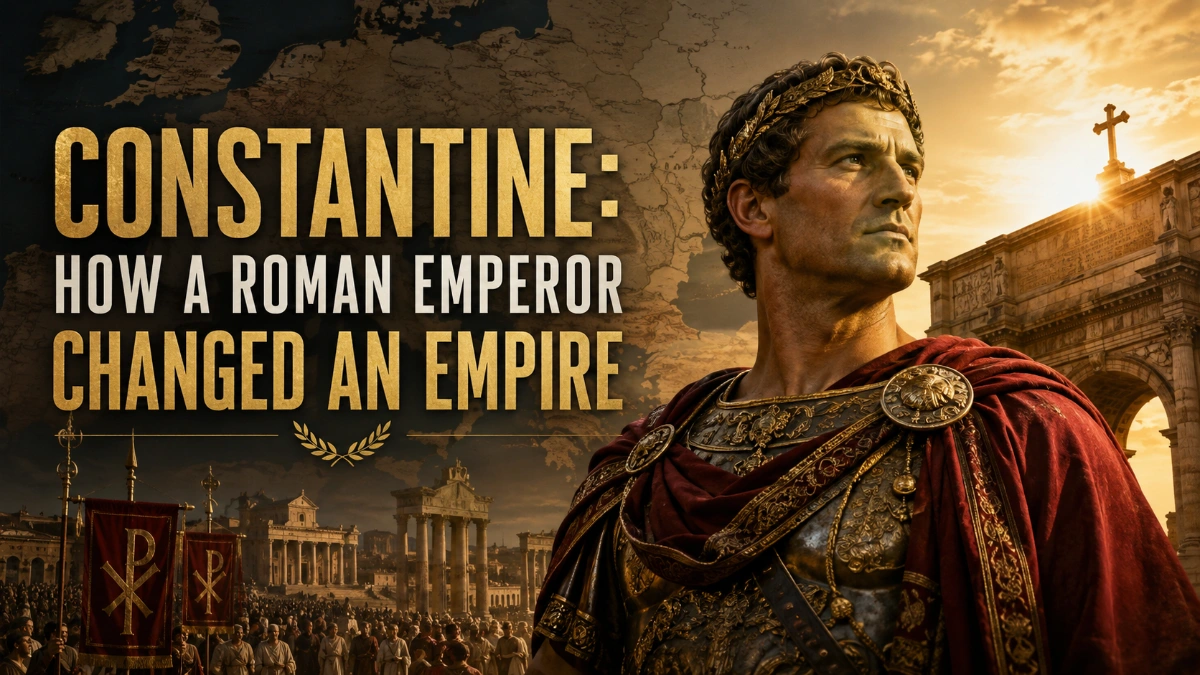
Constantine: Roman Emperor, Christianity and Legacy
Constantin, more commonly known in English as Constantine, was a Roman emperor whose rule altered the empire’s political structure, religious life, and geographical centre of power. Known as Constantine the Great, he ruled from 306 to 337 and rose during a period of competing emperors, defeated major rivals, backed Christianity, and created Constantinople as a new imperial capital.
The importance of Constantine rests on the combined effect of these actions. He did not simply win a series of civil wars: Constantine helped define a new model of imperial authority, one more closely connected to the Christian Church and increasingly centered on the eastern Mediterranean.
This article concerns Constantine I, the fourth-century Roman emperor. It does not refer to later rulers who shared the name or to Constantinople itself, the city named in his honor.
Why Constantine Still Matters
Constantine is central to the history of the Roman Empire because his reign connected political consolidation with religious and institutional change.
His legacy is usually understood through four major achievements:
- Constantine emerged from the divided politics of the Tetrarchy and became sole ruler of the Roman Empire.
- Constantine supported Christianity and gave Christian communities a secure legal position.
- Constantine called the First Council of Nicaea during a major dispute within Christianity.
- Constantine developed Constantinople as a new center of imperial government.
Each decision had consequences beyond his lifetime. Together, they influenced the later eastern empire, Christian institutions, and the historical transition from the Roman world to what later historians call the Byzantine Empire.
The Empire Constantine Inherited
The Roman Empire Constantine entered was not governed by one uncontested ruler. The Tetrarchy, introduced under Diocletian, divided responsibility among senior and junior emperors in an effort to make government and defense more manageable.
That system did not eliminate rivalry. The death or removal of an emperor created opportunities for competing claims, and the empire entered a period of political instability.
Constantine’s father, Constantius Chlorus, held imperial power in the west, placing Constantine close to the struggles that followed.
Constantine’s Path to Rule
In 306, Constantine was proclaimed emperor by his troops at York after the death of Constantius Chlorus. His position was contested, and Constantine’s authority developed through alliances, political calculation, and war.
Maxentius controlled Italy and Rome, while Licinius became a major power in the east. Constantine’s rise depended on overcoming these competing rulers and building control over a fragmented empire.
His success made Constantine the leading imperial figure in the west before he eventually became sole ruler of the Roman Empire.
The Milvian Bridge and Constantine’s Victory
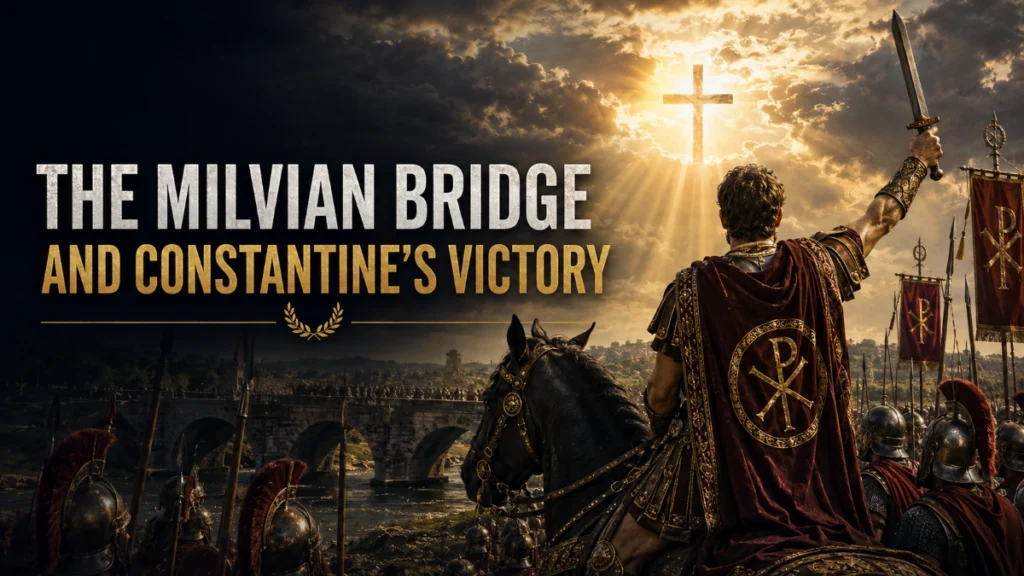
The Battle of the Milvian Bridge in 312 was a decisive victory for Constantine. Fought near Rome against Maxentius, it gave Constantine control of the western empire and secured his reputation as a successful military ruler.
Christian accounts written later connected Constantine’s victory with a vision or sign linked to Christ. Lactantius and Eusebius of Caesarea preserved influential versions of that tradition, though the meaning and timing of Constantine’s religious change remain open to interpretation.
For Constantine, the battle was both a political breakthrough and a defining moment in later Christian memory. It associated military victory, imperial legitimacy, and divine favor in a way that shaped how his reign would be remembered.
Constantine and Christianity
Constantine changed Christianity’s position within the Roman Empire. He supported the Church, restored property, funded religious building projects, and raised the public standing of Christian leaders.
In 313, Constantine and Licinius issued the Edict of Milan. It endorsed religious toleration, ended penalties imposed on Christians, and gave Christian communities greater legal security.
The Edict of Milan did not make Christianity the empire’s official religion. It did not create Christianity or establish the Church. Its significance was that Christianity could operate with legal protection after periods of persecution.
Constantine’s Conversion
Constantine is widely seen as the first Roman emperor to embrace Christianity openly. Yet the exact nature of his conversion remains debated because the surviving evidence does not provide a simple account of personal belief.
The tradition of a vision before the Milvian Bridge is central to this question. Constantine was baptized close to his death in 337, and his late baptism has been understood as evidence of a gradual or cautious religious commitment. Late baptism, however, was not unusual in the fourth century.
The evidence supports a careful conclusion: Constantine increasingly identified his rule with the Christian God and gave Christianity an unprecedented level of imperial support. His actions may have reflected conviction, politics, public image, or more than one of these factors at once.
What Constantine Did Not Do
Several common claims about Constantine need qualification.
- Constantine did not make Christianity the official religion of the Roman Empire.
- Constantine did not create Christianity.
- Constantine did not immediately end traditional Roman religious practices.
- Constantine did not personally resolve every theological disagreement within the Church.
These distinctions help explain why Constantine was a turning point without overstating the speed or completeness of change during his reign.
Constantine, Nicaea, and Church Unity
In 325, Constantine called the First Council of Nicaea. The council responded to a serious dispute associated with Arius concerning the relationship between Christ and God the Father.
Constantine’s concern was not only theological. Division among Christian communities threatened unity in a religion that had acquired growing public importance. His role was that of an emperor seeking cohesion, not that of a theologian creating doctrine.
The council produced a creed that became central to later Christian tradition. It did not bring immediate peace to every theological conflict, but it established a lasting precedent for interaction among emperors, church leaders, and doctrinal disputes.
Constantinople: Constantine’s New Capital
Constantine chose the ancient city of Byzantium for a new imperial capital. The city became Constantinople and was formally developed as an important political and ceremonial center.
The site stood between Europe and Asia and offered stronger access to important eastern regions of the empire. Constantinople therefore reflected Constantine’s strategic priorities as well as his wish to create a city closely associated with his authority.
Rome remained a powerful cultural and political symbol. Still, Constantinople gave the empire an additional center of government and strengthened the eastern half of the Roman world. Its later importance explains why Constantine’s decision is often viewed as one of his most enduring acts.
Reforms and Imperial Government
Constantine introduced changes in administration, military organization, currency, law, and court life. These reforms aimed to reinforce order after years of divided government and civil conflict.
His rule strengthened the imperial court and bureaucracy, continued developments in military organization, and shaped monetary policy. Constantine also used law and ceremony to emphasize the emperor’s role as the source of stability and authority.
Not every change began with Constantine, and not every consequence was immediate. Many measures continued earlier developments, while others became more important after his death. The wider effect was to make imperial government more centralized and court-centered.
Constantine’s Family and Succession
The family of Constantine was inseparable from the politics of his reign. His mother Helena became prominent in later Christian tradition. His wife Fausta and his son Crispus were linked to court events that remain difficult to explain with certainty.
The deaths of Crispus and Fausta are among the most debated parts of Constantine’s life. Because the surviving evidence is limited, later accounts should not be treated as final proof of what happened.
When Constantine died, his sons divided imperial authority. Their rivalry showed that even Constantine’s consolidation of power could not ensure a stable transfer of rule.
The Death of Constantine
Constantine remained involved in administration, religion, and succession during his final years. He was baptized shortly before his death in 337.
His death did not reverse the changes associated with his rule. The Roman Empire continued, but its religious direction, structures of authority, and eastern political focus had all been shaped by Constantine.
How Constantine Is Remembered
Constantine is called “the Great” because later generations regarded his reign as transformative. His military victories gave him control over a divided empire; his religious policies elevated Christianity’s public standing; and his new capital influenced the future of the eastern Roman world.
A balanced view of Constantine also recognises the harsher realities of his reign. His power was achieved through warfare, his court was marked by difficult family politics, and his policies had effects that reached far beyond his own time.
Constantine’s importance lies not in a single victory, law, or religious act. It lies in the way his decisions combined to redirect the Roman Empire and reshape the public history of Christianity.
Read also: Constantine: How One Emperor Changed Rome and Christianity
A Timeline of Constantine’s Reign
- 306: Constantine was proclaimed emperor at York after the death of Constantius Chlorus.
- 312: Constantine defeated Maxentius at the Battle of the Milvian Bridge.
- 313: Constantine and Licinius issued the Edict of Milan.
- 324: Constantine became sole ruler of the Roman Empire after defeating Licinius.
- 325: Constantine called the First Council of Nicaea.
- 330: Constantinople was formally dedicated as an imperial capital.
- 337: Constantine died after receiving baptism near the end of his life.
Frequently Asked Questions
Constantin refers here to Constantine I, commonly known in English as Constantine the Great. He was a Roman emperor who ruled from 306 to 337 and is known for defeating rival emperors, supporting Christianity, calling the Council of Nicaea, and developing Constantinople as an imperial capital.
Constantine was a Roman emperor who ruled from 306 to 337. He is known for defeating rival emperors, supporting Christianity, calling the Council of Nicaea, and founding Constantinople.
Constantine is called “the Great” because his victories, religious policies, reforms, and founding of Constantinople had a lasting effect on Roman and Christian history.
Constantine gave Christianity legal protection, supported the Church, restored property, funded religious building projects, and increased the public standing of Christian leaders.
No. Constantine supported Christianity and helped secure legal toleration, but he did not make it the official religion of the Roman Empire.
The Edict of Milan was a policy issued by Constantine and Licinius in 313 that supported religious toleration, ended penalties against Christians, and improved legal security for Christian communities.
Constantine defeated Maxentius near Rome in 312. The victory gave him control of the western empire and became associated with traditions about his Christian conversion.
Constantine increasingly identified his rule with the Christian God, supported Christianity openly, and was baptized shortly before his death. The precise nature and timing of his conversion remain debated.
Constantine developed Byzantium into Constantinople because of its strategic location between Europe and Asia and its access to eastern regions of the empire.
Constantine called the council in 325 to encourage unity during a major Christian theological dispute. He did not personally create the council’s doctrine.
Constantine died in 337 after receiving baptism near the end of his life.