
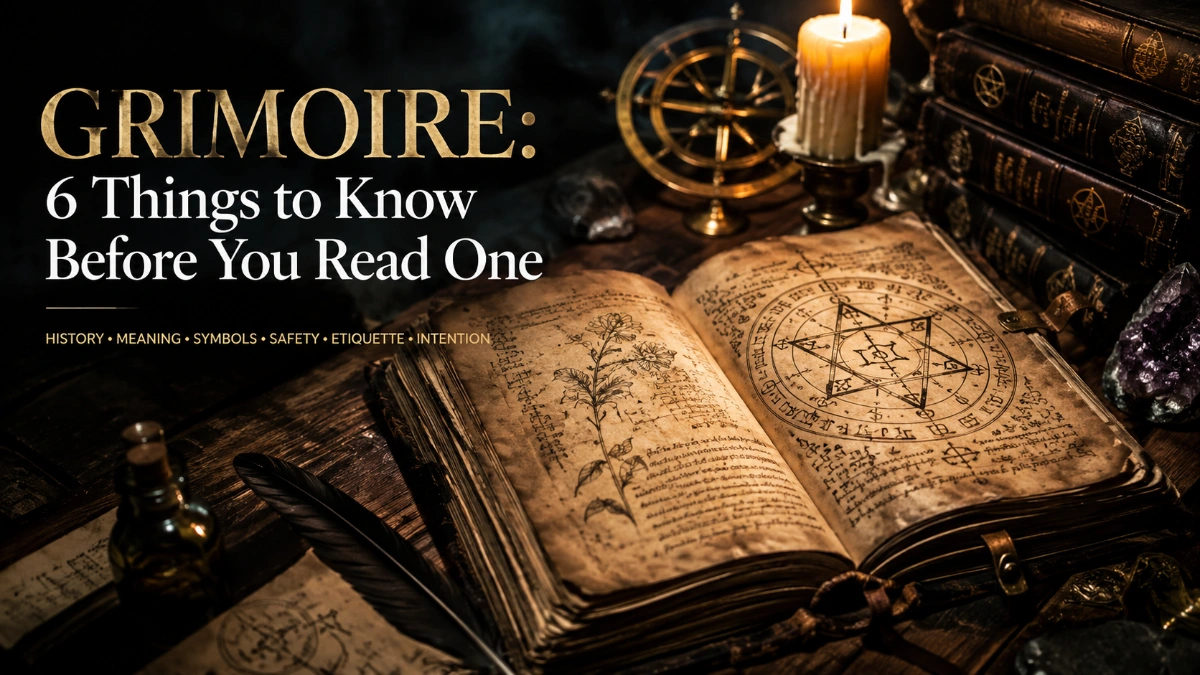
Grimoire: 6 Fascinating Facts About Historical Magic Books
A grimoire is a historical book or manuscript of magical instruction. It may contain prayers, invocations, symbols, astrological timing, charms, or directions for preparing ritual objects—but it is best understood as a cultural and historical text, not proof that its supernatural claims work.
Start With Context
The word grimoire is commonly used today as a broad label for magical manuals. That label can be helpful, but it should not make readers assume that every text belongs to one stable tradition or follows the same practices.
Many texts now grouped under this term were copied, translated, rearranged, and expanded over long periods. Some did not originally describe themselves as a grimoire at all. Their language, place of origin, religious setting, manuscript history, and later editorial changes all affect what a particular book means.
The word itself is generally connected to the Old French gramaire, a term associated with grammar and learned writing. Over time, it came to be linked with specialized, obscure, and eventually magical knowledge, though the exact linguistic path is not perfectly documented.
What You May Find Inside
A historical grimoire can look very different from a modern fantasy spellbook. Its contents may include:
- Prayers, sacred names, invocations, or conjurations
- Diagrams, seals, circles, alphabets, and symbolic signs
- Astrological timing and planetary associations
- Ritual preparation and instructions for making talismans or protective objects
- Charms or procedures related to protection, knowledge, healing, luck, or uncertain circumstances
These subjects were not always treated as separate categories by their writers. Religious language, astrology, folklore, ritual practice, and material remedies could sit together in the same manuscript because they reflected the intellectual and devotional world of the person who copied or used it.
A grimoire therefore tells readers about manuscript culture, belief, and social history as much as it tells them about magic.
Why Texts Differ So Much
The biggest mistake is assuming that a famous title identifies one unchanged original book. Before modern print standardization, texts circulated through hand-copying. Scribes could omit passages, add notes, combine materials, translate wording, or adapt instructions for different readers.
As a result:
- An attributed author may be legendary, symbolic, or unknown.
- A title can describe a family of related manuscripts rather than one authoritative version.
- The date of a surviving copy may be later than the composition of some of its source material.
- A modern edition may be a translation, reconstruction, anthology, adaptation, or entirely new work.
This is why provenance matters. When evaluating a grimoire, the useful questions are not only “What is the title?” but also “Which manuscript?”, “Which language?”, “Who edited it?”, and “What has been changed?”
Three Historical Reference Points
The Key of Solomon
The Clavicula Salomonis, commonly called the Key of Solomon, is presented as the work of King Solomon. The attribution is pseudepigraphical: the text was placed under a prestigious historical or legendary name rather than verified as Solomon’s own writing.
The text survives in varied manuscript forms. A surviving German manuscript associated with the tradition is part of a later expurgated text group, showing how transmission and editorial change shaped works associated with this title.
The Sworn Book of Honorius
The Liber iuratus Honorii, or Sworn Book of Honorius, belongs to medieval ritual-magic literature and survives through later manuscript witnesses. Its authorship, composition, and development remain matters of historical interpretation rather than settled facts.
It is a useful example of why a grimoire should not be reduced to one author, one date, or one completely stable text.
The Picatrix
The Picatrix is the Latin name for a work known in Arabic as Ghāyat al-Ḥakīm. It was composed in Arabic in Moorish Spain before the middle of the eleventh century, and the Latin version known in medieval Europe dates from around 1250.
The text brings together astronomy, astrology, alchemy, mystical knowledge, and magic. Its history demonstrates that European magical writing developed through translation and exchange, not in isolation from Arabic-language scholarly traditions.
Similar Terms, Different Uses
| Term | Meaning | How it differs |
| grimoire | A historical or modern book of ritual magical instruction | Usually implies a text with magical procedures, transmission history, or ritual content |
| Spellbook | A general book of spells | Broader popular term; may refer to fiction, games, or contemporary practice |
| Book of Shadows | A ritual text associated with Wicca and related Pagan traditions | Often personal, coven-specific, or tradition-specific rather than a historical medieval manuscript |
| Occult text | Writing about esoteric or hidden knowledge | May discuss alchemy, mysticism, divination, or philosophy without providing ritual instructions |
A grimoire may be called a spellbook in casual conversation, but the historical meaning is usually more specific. Likewise, a Book of Shadows can overlap with modern magical practice without being an ancient synonym for every ritual manuscript.
How to Judge a Modern Edition
Modern books marketed with ancient-looking titles can range from careful scholarly editions to imaginative rewrites. Use this checklist before treating one as a historical source.
- Check the provenance. Look for a named manuscript, archive, library collection, or catalogue reference.
- Identify the editor or translator. A credible edition explains who prepared it and which source text they used.
- Look for editorial notes. Good editions identify missing pages, variant readings, translation choices, and modern additions.
- Separate history from adaptation. New illustrations, commentary, rewritten wording, or added rituals may not belong to the original source.
- Question certainty. Claims of a perfectly preserved ancient text require evidence, especially when no manuscript details are provided.
- Keep belief and verification separate. A text’s historical importance does not demonstrate that its rituals, medical claims, legal claims, or supernatural promises are effective.
These checks can reveal how transparent an edition is, but they do not guarantee accuracy, authenticity, or safety. Historical and modern magical texts should never replace professional guidance on health, law, finance, mental health, or personal safety.
Why grimoires Still Matter
A grimoire matters because it preserves evidence of how people sought protection, knowledge, certainty, and spiritual meaning in uncertain times. It also shows how texts changed when they moved between scribes, languages, communities, and later print markets.
Today, the word appears in novels, films, games, art, and contemporary spiritual communities. In fiction, it often means a mysterious forbidden volume. In historical research, a grimoire is something more specific: a text whose value lies in its particular history, transmission, language, and cultural setting.
See this more: grimoire: 6 Fascinating Truths About Ancient Magic Books
Frequently Asked Questions
Yes. Historical magical manuscripts and printed manuals survive in library and archive collections. Their existence confirms that people wrote, copied, and circulated such material, but it does not confirm supernatural claims within the texts.
There is no reliable evidence that King Solomon wrote it. The attribution is generally considered pseudepigraphical, meaning the name was used to give the text authority.
No. “Spellbook” is a broad term that can include fictional, modern, religious, folkloric, or game-related books. A grimoire is more often used for ritual manuals with a recognizable historical or textual context.
The terms can overlap in casual use, but they are not identical. A Book of Shadows is most closely connected with Wicca and related contemporary Pagan traditions, while a grimoire usually refers more broadly to historical magical manuals.
A historical grimoire is primarily a cultural and historical document. Readers should not rely on ritual instructions or unverified medical, legal, financial, or safety claims in any magical text as professional advice.
Before standardized publishing, scribes and translators copied texts manually. They could add, omit, translate, rearrange, or combine material, creating multiple versions under the same title.
Yes. Some editions are careful translations or facsimiles, while others combine sources, simplify difficult material, add modern content, or use historical claims mainly for marketing. Check the manuscript source and editorial notes before relying on one as a historical reference.