
spoint slope form: Formula, Graphing & Conversions
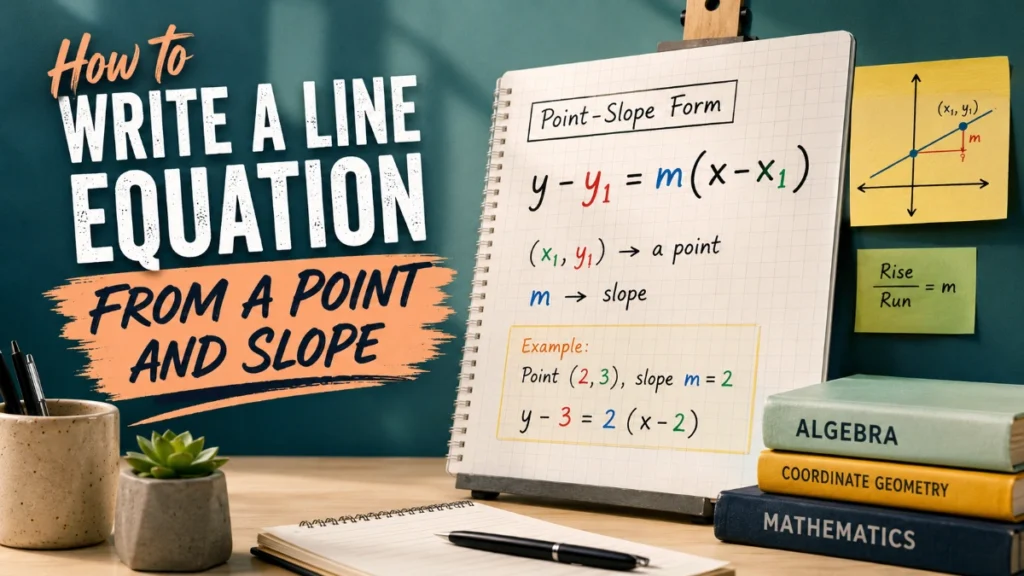
Point slope form is the equation format to use when you know a line’s slope and one point that lies on it. Its standard form is:
y−𝑦1=m(x−x1)y-y1=m(x-x1)y−y1=m(x−x1)
The value mm is the slope, and (x1,y1)(x1,y1)(x1,y1) is the known point. From there, you can leave the equation in point-slope form, graph the line, test whether a point fits it, or rewrite it in another linear-equation form.
The Idea Behind the Formula
A straight line changes at a constant rate. Point-slope form captures that rate by comparing an unknown point on the line with a point you already know.
In the equation
y−y1=m(x−x1),y-y1=m(x-x1),y−y1=m(x−x1),
the expression y−y1y-y1y−y1 measures vertical change, while x−x1x-x1x−x1 measures horizontal change. The slope mmm links those changes.
Read Each Part Correctly
| Expression | What it represents |
| mmm | The slope of the line |
| (x1,y1)(x1,y1)(x1,y1) | A known point on the line |
| (x,y)(x,y)(x,y) | Any point that belongs to the same line |
| y−y1y-y1y−y1 | Change in the vertical direction |
| x−x1x-x1x−x1 | Change in the horizontal direction |
The small 1s are labels for the known points’ coordinates. They do not mean that x or y is being multiplied by 1.
For a point (3,5)(3,5)(3,5), substitute x1=3×1=3×1=3 And y1=5y1=5y1=5.
When This Form Is the Best Choice
Choose point slope form when a problem supplies:
- A slope
- One point on the line
It also works after you calculate a slope from two points. It does not apply in the ordinary way to a vertical line, since vertical lines have undefined slope; their equation is written as x=ax=ax=a.
Write a Line Equation From a Point and Slope
The formula is short, but precision matters. Most errors occur when a coordinate is placed in the wrong position, or its sign is changed during substitution.
Put the Given Values in Place
Assume the slope is 3 and the line goes through (2,7)(2,7)(2,7).
m=3,x1=2,y1=7m=3, x1=2, y1=7m=3,x1=2,y1=7
Substituting these values into the formula produces:
y−7=3(x−2)y-7=3(x-2)y−7=3(x−2)
That is the full answer if the question asks for point slope form.
Preserve Negative Signs
Suppose the line has slope 3 and passes through (−2,−4)(-2,-4)(−2,−4). Substitute the signed values first:
y−(−4)=3(x−(−2))y-(-4)=3(x-(-2))y−(−4)=3(x−(−2))
Then simplify:
y+4=3(x+2)y+4=3(x+2)y+4=3(x+2)
The original equation has subtraction built into it. Therefore, subtracting a negative coordinate creates addition.
Why Parentheses Help
Parentheses show the value being substituted before any signs are simplified:
x−(−2)=x+2x-(-2)=x+2x−(−2)=x+2
y−(−4)=y+4y-(-4)=y+4y−(−4)=y+4
Without them, it is easy to use x−2x-2x−2 or y−4y-4y−4, which would describe a line through a different point.
Leave It Alone Unless a New Form Is Requested
The equation
y−7=3(x−2)y-7=3(x-2)y−7=3(x−2)
does not need to be expanded to count as a correct answer. It is already in point slope form.
Expansion is useful only when you need another format, such as slope-intercept form or standard form.
Work Through Different Types of Slopes
The equation’s structure remains stable whether a slope is positive, negative, or fractional. Only the values you substitute change.
Positive Slope Example
A line has slope 4 and passes through (1,3)(1,3)(1,3):
y−3=4(x−1)y-3=4(x-1)y−3=4(x−1)
To rewrite the line in slope-intercept form, distribute the 4:
y−3=4x−4y-3=4x-4y−3=4x−4
Then add 3:
y=4x−1y=4x-1y=4x−1
Negative Slope Example
A line has slope −2-2−2 and passes through (5,1)(5,1)(5,1):
y−1=−2(x−5)y-1=-2(x-5)y−1=−2(x−5)
Distribute:
y−1=−2x+10y-1=-2x+10y−1=−2x+10
Add 1:
y=−2x+11y=-2x+11y=−2x+11
A negative slope means the line moves downward from left to right.
Fractional Slope Example
For a slope of 23\frac{2}{3}32 through (6,−1)(6,-1)(6,−1):
y−(−1)=23(x−6)y-(-1)={2}{3}(x-6)y−(−1)=32(x−6)
y+1=23(x−6)y+1=\frac{2}{3}(x-6)y+1=32(x−6)
The slope 23{2}{3}32 represents a rise of 2 and a run of 3. Many parallel lines can have that slope, but the point (6,−1)(6,-1)(6,−1) identifies the particular line in this equation.
Find Point Slope Form Using Two Points
When a problem provides two coordinate pairs, the missing piece is the slope. Calculate it before using point slope form.
Calculate the Slope
For (2,3)(2,3)(2,3) and (6,11)(6,11)(6,11), use the slope formula:
m=y2−y1x2−x1m={y2-y1}{x2-x1}m=x2−x1y2−y1
m=11−36−2m={11-3}{6-2}m=6−211−3
m=84m={8}{4}m=48
m=2m=2m=2
Select One Complete Point
Now combine the slope of 2 with either entire ordered pair. Using (2,3)(2,3)(2,3):
y−3=2(x−2)y-3=2(x-2)y−3=2(x−2)
Using (6,11)(6,11)(6,11) instead gives:
y−11=2(x−6)y-11=2(x-6)y−11=2(x−6)
Both equations describe the same line, even though they begin with different known points.
Confirm the Result
Substitute the second point into the first equation:
y−3=2(x−2)y-3=2(x-2)y−3=2(x−2)
11−3=2(6−2)11-3=2(6-2)11−3=2(6−2)
8=88=88=8
The equality confirms that (6,11)(6,11)(6,11) is on the line.
Same xxx-Coordinate: A Different Case
Points such as (4,2)(4,2)(4,2) and (4,−5)(4,-5)(4,−5) create a vertical line:
x=4x=4x=4
Because the slope is undefined, there is no ordinary point slope form for that line.
Turn Point Slope Form Into Other Forms
A line can have several equivalent equations. The shape and position of its graph remain the same when you rewrite the equation.
Move to Slope-Intercept Form
Slope-intercept form is:
y=mx+by=mx+by=mx+b
In this equation, mmm is the slope and bbb is the yyy-intercept.
Start with:
y−5=2(x−3)y-5=2(x-3)y−5=2(x−3)
Distribute:
y−5=2x−6y-5=2x-6y−5=2x−6
Isolate y:
y=2x−1y=2x-1y=2x−1
Rearrange Into Standard Form
Standard form is commonly written as:
Ax+By=CAx+By=CAx+By=C
Using the same starting equation:
y−5=2(x−3)y-5=2(x-3)y−5=2(x−3)
y−5=2x−6y-5=2x-6y−5=2x−6
Move the variable terms and constant to obtain:
2x−y=12x-y=12x−y=1
Recognize Equivalent Equations
All three of these equations represent the same line:
y−5=2(x−3)y-5=2(x-3)y−5=2(x−3)
y=2x−1y=2x-1y=2x−1
2x−y=12x-y=12x−y=1
Point slope form makes a known point and slope visible. Slope-intercept form displays the slope and yyy-intercept. Standard form can be used for a vertical equation such as x=7x=7x=7, though its slope is not immediately visible.
Graph a Line Without Converting First
You can graph directly from point slope form because the equation contains both a plotted point and a slope.
Begin at the Given Point
Look at:
y−4=−12(x−3)y-4=-\frac{1}{2}(x-3)y−4=−21(x−3)
The known point is (3,4)(3,4)(3,4). Mark that point first.
The expression x−3x-3x−3 corresponds to an xxx-coordinate of 3, because the formula is x−x1x-x_1x−x1. It does not indicate −3-3−3.
Apply Rise Over Run
The slope is:
−12-\frac{1}{2}−21
Starting from (3,4)(3,4)(3,4), move 2 units right and 1 unit down. That gives a second point on the line.
You can also move 2 units left and 1 unit up. A positive slope rises from left to right, while a negative slope falls from left to right.
Use Point Slope Form for Related Lines
Beyond writing a basic equation, point slope form can help build parallel, perpendicular, and horizontal lines.
Horizontal Lines
A horizontal line has a slope of 0. Through (2,−3)(2,-3)(2,−3), the form becomes:
y−(−3)=0(x−2)y-(-3)=0(x-2)y−(−3)=0(x−2)
y+3=0y+3=0y+3=0
y=−3y=-3y=−3
All points on this line have the same yyy-coordinate.
Parallel Lines
Parallel lines use equal slopes. If a known line has slope −4, a parallel line has slope −4 as well.
With that slope and a point on the new line, substitute directly into point slope form.
Perpendicular Lines
For non-vertical lines, slopes of perpendicular lines are negative reciprocals. A slope of 23{2}{3}32 corresponds to a perpendicular slope of −32{3}{2}−23.
Once you know the new slope and the given point, the point slope formula supplies the equation.
Compare the Main Forms of a Line
| Equation form | General equation | Most useful when | Limitation |
| Point slope form | y−y1=m(x−x1)y-y1=m(x-x1)y−y1=m(x−x1) | A slope and one point are supplied | It does not show the yyy-intercept directly |
| Slope-intercept form | y=mx+by=mx+by=mx+b | You need the slope and yyy-intercept | Finding bbb can require extra algebra |
| Standard form | Ax+By=CAx+By=CAx+By=C | A general equation format or a vertical line is required | The slope may not be obvious |
Point Slope Form or Slope-Intercept Form?
With slope 3 and point (4,10)(4,10)(4,10), point slope form is immediate:
y−10=3(x−4)y-10=3(x-4)y−10=3(x−4)
Use slope-intercept form when the yyy-intercept is needed or when you want to graph from that intercept.
Point Slope Form or Standard Form?
For a non-vertical line, point slope form is usually the easier starting format when a slope and point are available. Standard form is useful when the task specifically requests it and for vertical lines such as:
x=7x=7x=7
Check for These Errors Before You Finish
A correct formula can still lead to a wrong equation if the values are handled carelessly.
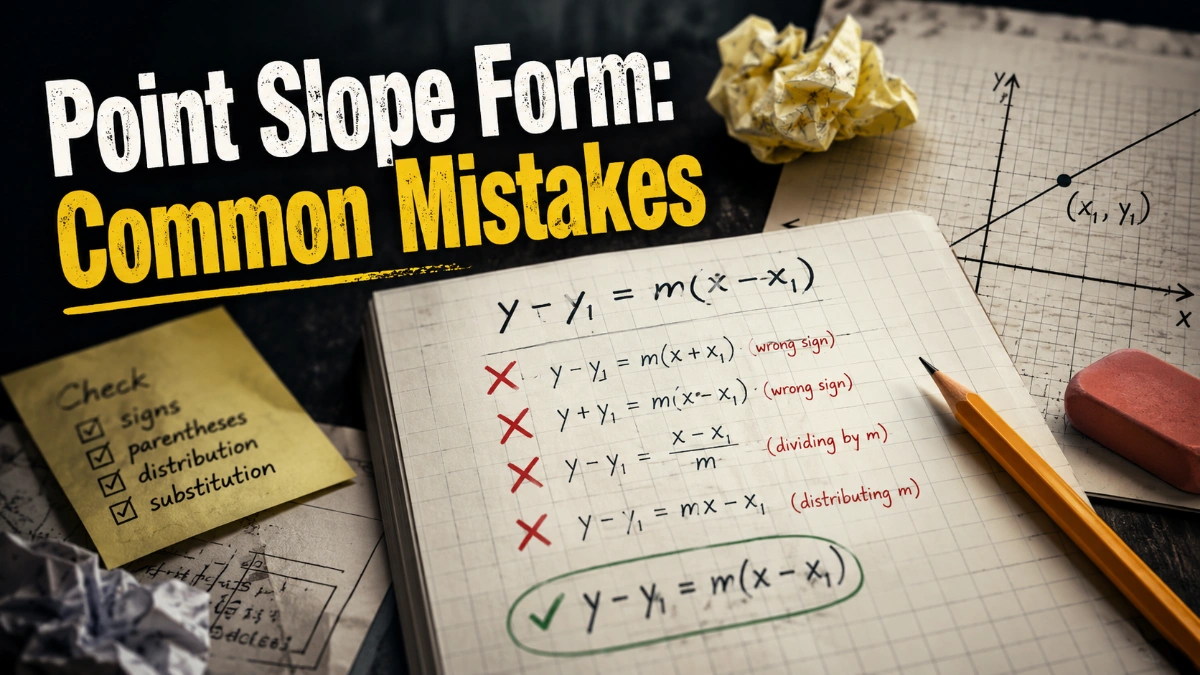
Reversing a Sign
For the point (−3,4)(-3,4)(−3,4), write:
y−4=m(x−(−3))y-4=m(x-(-3))y−4=m(x−(−3))
Then simplify to:
y−4=m(x+3)y-4=m(x+3)y−4=m(x+3)
The form x−3x-3x−3 would place the line through the wrong xxx-coordinate.
Switching Coordinate Positions
For (7,−2)(7,-2)(7,−2), the correct assignments are:
x1=7,y1=−2×1=7,\qquad y_1=-2×1=7,y1=−2
Therefore:
y−(−2)=m(x−7)y-(-2)=m(x-7)y−(−2)=m(x−7)
The order of every coordinate pair remains (x,y)(x,y)(x,y).
Combining Coordinates From Separate Points
If two points are provided, choose one complete pair for (x1,y1)(x1,y1)(x1,y1). Do not combine the xxx-coordinate from one point with the y-coordinate from another.
Distributing a Negative Incorrectly
Given:
y−1=−3(x−4),y-1=-3(x-4),y−1=−3(x−4),
distribution gives:
y−1=−3x+12y-1=-3x+12y−1=−3x+12
The positive 12 comes from multiplying two negative values.
Not Testing the Original Point
Substitute the known point into your completed equation. If the two sides differ, inspect the slope, the coordinate pair, and every sign.
A Final Point Slope Form Routine
- Find the slope mmm.
- Identify a complete point (x1,y1).
- Use y−y1=m(x−x1)y-y1=m(x-x1)y−y1=m(x−x1).
- Substitute negative values inside parentheses.
- Simplify double negatives.
- Keep the equation as written unless another form is needed.
- Distribute only when converting equation forms.
- Check the original point.
- Write vertical lines as x=ax=ax=a.
Point-slope form is a direct bridge between a line’s slope and its location on the coordinate plane. It becomes dependable when you treat signs carefully, keep coordinate pairs intact, and verify the completed equation.
Read more: point slope form: Step-by-Step Guide
FAQs
The point slope form equation is:
y−y1=m(x−x1)y-y1=m(x-x1)y−y1=m(x−x1)
It uses a line’s slope mmm and one known point (x1,y1)(x1,y1)(x1,y1).
Identify the slope and one ordered pair on the line. Then assign the point’s first coordinate to x1x1x1 and the second coordinate to y1y1y1.
An equation such as y−7=3(x−2)y-7=3(x-2)y−7=3(x−2) is already in point slope form. It only needs expansion if another equation form is requested.
Use parentheses when substituting it. For example, a point with y1=−4y1=-4y1=−4 creates y−(−4)y-(-4)y−(−4), which simplifies to y+4y+4y+4.
When two points are on the same line, either point can be used in the formula. The resulting equations can look different but still represent the same line.
Plot the known point, then use the slope as rise over run to find another point. Draw the line through those points.
A vertical line is written as x=ax=ax=a, where aaa is its fixed xxx-coordinate. Its slope is undefined.
A horizontal line has slope 0 and has an equation of the form y=ay=ay=a.
Yes. Parallel lines have equal slopes. Use the shared slope and a point on the new line in the point slope formula.
For non-vertical lines, perpendicular slopes are negative reciprocals. For example, 23{2}{3}32 and −32{3}{2}−23 are perpendicular slopes.