
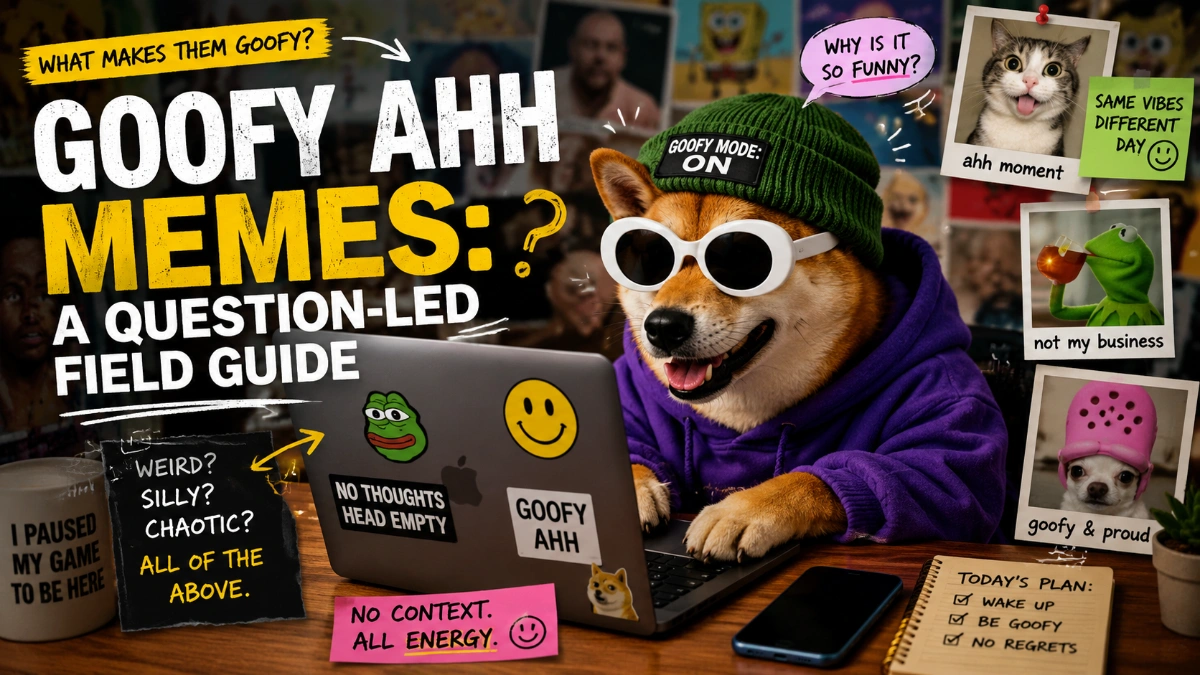
goofy ahh memes: 5 Quick Answers to a Silly Trend
What are goofy ahh memes? They are intentionally absurd posts—short videos, image edits, or sound-driven remixes—where the joke comes from a deliberate, oversized mismatch between what viewers expect and what actually happens on screen.
This guide answers the questions people usually ask in order: what the phrase means, where it came from, why the format is funny, and how to make or share one without it feeling forced.
What does “goofy ahh” actually mean?
“Goofy ahh” is commonly used as a phonetic version of “goofy ass,” meaning silly, ridiculous, or wildly unserious. It can describe a person, sound, caption, or entire video.
The phrase and the meme genre overlap but are not identical. Calling a strange noise a “goofy ahh sound” is different from goofy ahh memes as a broader style built around exaggerated, off-key humor. In everyday use, it is pronounced with a long “a,” closer to “ass” than “aww.”
Did TikTok invent this phrase?
No. The phrase has AAVE context, and treating it as a TikTok invention misrepresents where it comes from. The exact original coiner is unknown, but documented online use dates to at least 2009.
TikTok’s role was amplification, not creation. The platform gave the phrase and its related remix style much wider visibility in late 2021, and the “goofy ahh sound” comment became especially common in early 2022 alongside cartoon-style audio effects. A safer way to describe this: TikTok popularized an existing expression rather than originating it.
Why do the edits feel so random?
They usually are not random in construction, even when they look chaotic. Most goofy ahh memes use a setup-then-interruption pattern: something ordinary is established first, then broken by one exaggerated element.
| Comic step | What it does | Example |
| Setup | Establishes a normal expectation | A quiet clip of someone opening a door |
| Interruption | Introduces one oversized, mismatched element | A theatrical snore or cartoon sound at that exact moment |
| Payoff | Gives the viewer a beat to register the mismatch | The scene continues as if nothing unusual happened |
This is why the same idea can fail if every element is strange from the start: without a baseline, there is no clear moment for the joke to land.
Why is sound so central to the format?
Audio is often the fastest way to shift a plain clip into goofy ahh memes territory. Cartoon-like effects, distorted voices, and deliberately indiscernible noises are common because they instantly clash with an otherwise normal visual.
A sound doesn’t need to be trending to work; it only needs the wrong scale or tone for the scene. One dominant audio choice usually reads more clearly than several competing effects layered together, since overlapping noise buries the contrast that makes the joke recognizable.
How do I make one that actually works?
Building goofy ahh memes that land, rather than just looking cluttered, comes down to a short sequence:
- Choose a clip, image, or caption with a clear, readable baseline.
- Pick a single disruption — a sound, freeze-frame, zoom, or speed change.
- Place that disruption where viewers expect something ordinary to happen.
- Avoid adding extra effects that compete with the main contrast.
- Check the edit without its caption; if the joke disappears, simplify it.
Dense, layered edits can still work, but they need a discernible pattern underneath the noise, not just volume.
What should I avoid when sharing one?
Keep the target of the joke on the edit, the premise, or an invented scenario rather than an identifiable private person who didn’t choose to be part of it. Content that only works by mocking a stranger tends to read as ridicule, not playful absurdity.
Favor your own footage, a platform’s built-in remix tools, or media explicitly available for reuse. This is practical, non-legal guidance; actual permission and copyright requirements vary by platform, source, and location.
Quick answers (at a glance)
- Meaning: “Silly,” “ridiculous,” or “goofy ass,” used online.
- Origin: Unclear coiner; documented use since at least 2009; TikTok amplified it in 2021-2022.
- Core mechanic: Setup, then an oversized mismatch, then a beat to register it.
- Common ingredient: An exaggerated or mismatched sound effect.
- Failure mode: No baseline, or too many competing effects at once.
- Sharing rule: Target the premise, not a private person; use footage you can reuse.
Read more: Goofy Ahh Memes: A Guide to the Phrase, Format, and Funny Timing
Frequently Asked Questions
It means something is silly, ridiculous, or comically unserious — used as slang derived from “goofy ass.”
Its exact coiner is unknown. Documented online use goes back to at least 2009, and it has AAVE context; TikTok increased its visibility from 2021 onward.
No. Sound is common, but visual mismatches, awkward pacing, and absurd captions can create the same effect without audio.
With a long “a” sound, closer to “ass” than “aww” — commonly described that way in online usage guides.
Usually because there’s no clear baseline before the disruption, or too many competing effects bury the single contrast that would otherwise be the joke.
It’s safer to use your own footage, a platform’s remix feature, or explicitly reusable material. This isn’t legal advice, since permission rules vary by platform and source.
Not exactly. “Goofy ahh” leans toward playful, comic silliness, while “cringe” more often signals discomfort or embarrassment rather than affectionate absurdity.