
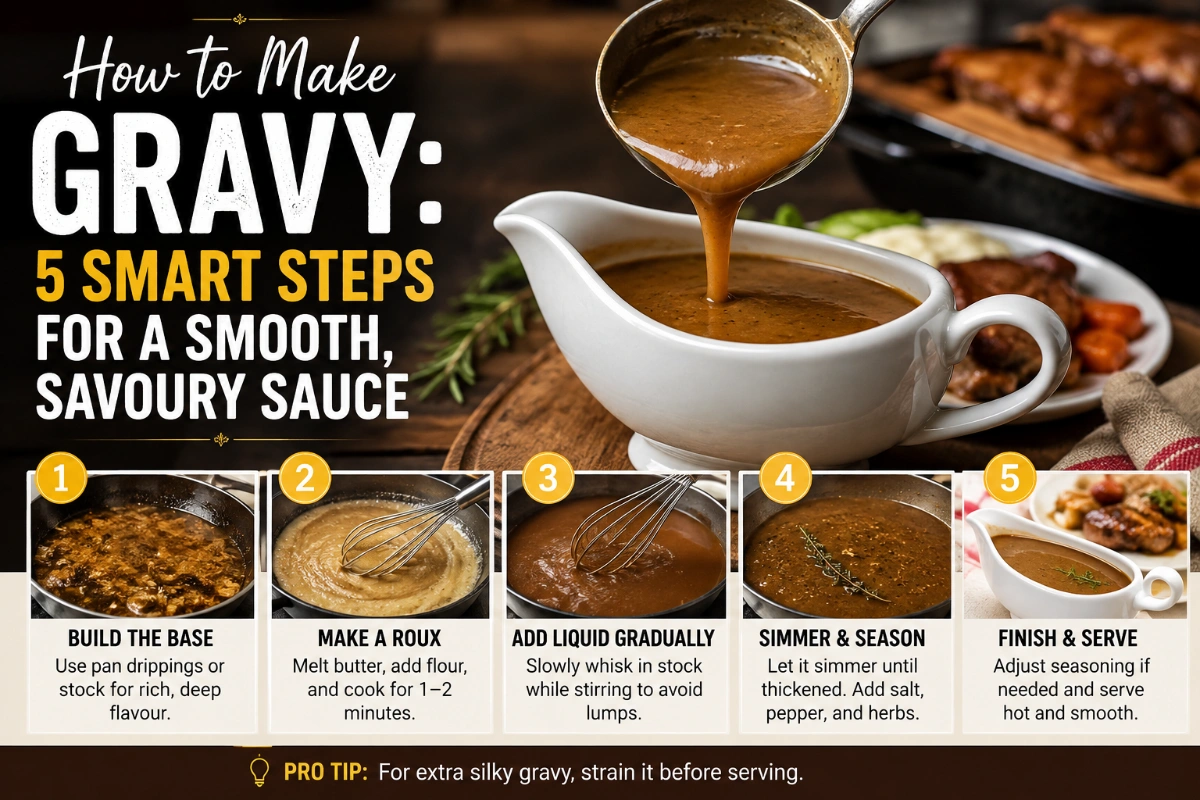
how to make gravy: Smooth Results with Drippings or Stock
Gravy comes together when a cooked flour-and-fat base is gradually loosened with stock or roasting juices. The process is simple: make a roux, whisk in warm liquid, simmer until it coats a spoon, then season once the flavour has concentrated.
Begin with the base
For about 2 cups of medium gravy, gather:
- 3 to 4 tablespoons separated roast fat, butter, or another cooking fat
- 3 to 4 tablespoons plain (all-purpose) flour
- 2 cups warm stock, pan juices, or a combination
- Freshly ground black pepper
- Salt, if needed
- Optional: a little water, stock, or dry wine for deglazing
The proportions are a starting point rather than a fixed outcome. Stock strength, the salt in drippings, evaporation, and the temperature at which you serve the gravy all change its final texture and flavour.
Build flavour first
If you have roasted meat or poultry, pour the liquid from the pan into a heatproof jug and allow it to settle. Spoon off the fat for the roux, keeping the cooking juices separately.
Set the roasting pan over low to medium heat. Add a small splash of water, stock, or dry wine and scrape the browned bits from the bottom with a wooden spoon. Those browned bits and concentrated roasting juices add savoury depth.
This is the useful starting point for how to make gravy from a roast: use enough separated fat to form the roux, then use the juices and deglazed pan residue to supply flavour.
Make the roux
Put 3 to 4 tablespoons of fat in a saucepan or the roasting pan. Whisk in the same amount of flour until it forms a smooth paste and no dry flour remains.
Cook over moderate heat, stirring continuously, until the mixture smells lightly toasted rather than raw. Keep the roux pale for a classic gravy; a more deeply browned roux brings a toastier colour but has less thickening power.
A roux is the foundation of how to make gravy with a smooth, cohesive texture. The fat coats the flour before liquid arrives, helping the starch disperse more evenly.
Add liquid without lumps
Warm stock or pan juices are easiest to incorporate. Add a small splash to the roux and whisk until you have a thick, smooth paste.
Continue adding the remaining liquid in several additions, whisking after each one. Once the gravy is fluid, bring it to a gentle simmer and stir often so it does not stick at the edges of the pan.
The most reliable technique for how to make gravy without lumps is slow liquid addition at the beginning. After the roux is smoothly loosened, you can add the rest of the liquid more freely.
Judge when it is ready
Let the gravy simmer until it coats the back of a spoon and flows off in a smooth stream. It should be easy to pour, not stiff or gluey.
Take it off the heat while it is slightly looser than your serving preference. Flour-thickened gravy becomes firmer as it cools, so waiting for it to look very thick in the pan can leave you with a heavy sauce on the plate.
Taste only after it has simmered. Add black pepper, then salt only if required; drippings and stock can both be salty, and reduction concentrates salt further.
Correct the texture
Knowing how to make gravy also means knowing how to repair it while it is still hot.
Gravy is too thin
Simmer for a few minutes longer before adding another thickener. Extra cooking may be all it needs.
If it remains thin, choose the method that suits the finish you want:
- Classic, opaque gravy: Cook a small additional roux with equal parts fat and flour, then whisk it into the simmering gravy.
- Fast thickening: Mix cornflour (cornstarch) with cold water until lump-free. Whisk it into the hot gravy in small additions and heat only until the sauce thickens and clears.
A flour-and-water paste can work, but it needs thorough cooking and is more likely to make a flour-based gravy uneven if added too quickly.
Gravy is too thick
Whisk in warm stock, water, or milk a tablespoon at a time. Let it return to a gentle simmer before assessing it again.
Gravy looks oily
Skim fat from the surface, then whisk well. If the sauce still feels heavy, add a little stock after skimming. Dilution alone cannot fully correct a gravy that began with too much fat.
Make it without drippings
You do not need a roasting pan to make a satisfying gravy. Melt 3 to 4 tablespoons of butter, whisk in the same amount of flour, cook the roux until lightly toasted, and gradually add 2 cups of warm stock.
For how to make gravy that fits the meal, use chicken stock with poultry, beef stock with beef dishes, or vegetable or mushroom stock for a meat-free version. If the flavour seems flat, add pepper, a little salt if needed, or a modest amount of browned onions or mushrooms.
Keep the seasoning balanced
Salt is not a final flourish to add automatically. Its effect depends on the drippings, stock, and reduction, so it belongs near the end of the process.
Use herbs sparingly. Sage and thyme can suit poultry, while rosemary is stronger and can quickly dominate. A small splash of dry wine can work well for deglazing if it suits the main dish; let it reduce briefly before adding the stock.
When you are learning how to make gravy, restrained seasoning is usually more useful than a long list of additions. The gravy should support the roast, potatoes, or vegetables rather than overpower them.
Store and reheat safely
Cool leftover gravy promptly and refrigerate it in a shallow covered container. Use refrigerated gravy within 1 to 2 days.
For longer storage, freeze it for up to 2 to 3 months for best quality. Thaw it in the refrigerator when practical, then reheat while whisking until it reaches a rolling boil. Add a splash of stock or water if it has thickened during storage.
Read more: How to Make Gravy: 5 Reliable Steps for Smooth, Savoury Results
Frequently Asked Questions
For about 2 cups of medium gravy, start with 3 to 4 tablespoons each of fat and flour and about 2 cups of liquid. Treat this as a starting formula, then adjust by simmering or adding liquid.
Yes, especially if you have flavourful drippings and browned bits from a roasting pan. Without drippings, stock usually gives a fuller savoury result.
The flour-thickened sauce firms as its temperature falls. Take it off the heat while it is slightly looser than the texture you want to serve.
Flour produces traditional opaque, roux-based gravy. Cornflour gives a clearer, glossier result and is useful for quick adjustments.
Use darker pan juices or stock, or cook the roux slightly longer for a toastier colour. Avoid taking the roux too far, because a very dark roux thickens less and may taste bitter.
The roux or finished gravy needs more gentle cooking. Simmer it, stirring often, until the raw flour taste disappears.
Whisk in unsalted stock or water a little at a time, tasting after each addition. If it becomes too thin, simmer gently or add a small extra roux.
Yes. Make it up to 1 to 2 days ahead, chill it promptly, then reheat it to a rolling boil while whisking. Keep a little stock nearby to loosen it before serving.