
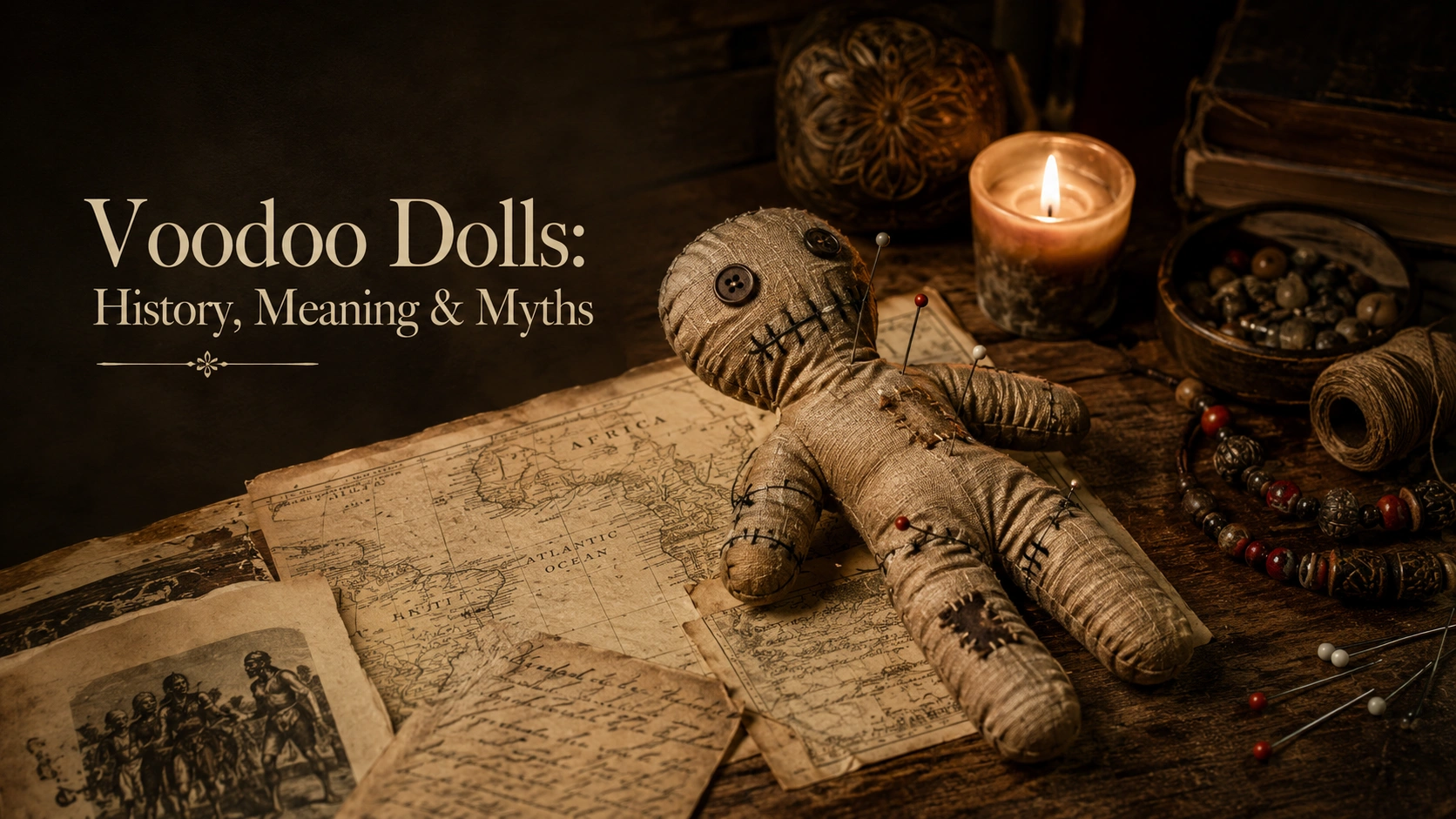
Voodoo Doll: Meaning, History, Origins & Common Myths
Voodoo Doll: What History Actually Shows
Most people picture a voodoo doll as a small human-shaped figure with pins stuck into it to cause pain or harm. That image is familiar, but it does not accurately describe the full history of the object or the religious traditions associated with the word “voodoo.”
The history is more complicated.
Figures called bocio, made by Fon artists and ritual specialists in what is now Benin, are documented by major museums as empowered objects connected with protection, spiritual power, and other purposes. The Metropolitan Museum of Art, for example, describes bocio as figures associated particularly with protection, while Smithsonian collections document examples used in contexts involving protection, power, illness, theft, travel, and, in some cases, potential harm.
At the same time, it would be misleading to simply declare that every modern voodoo doll is a direct descendant of bocio. The history of small ritual figures, European poppet traditions, Haitian Vodou, and Louisiana Voodoo involves different cultures and periods, and the evidence does not support reducing them to one simple lineage.
So what is a voodoo doll actually supposed to mean?
The most accurate answer is that “voodoo doll” is largely a modern popular label for several different kinds of human-shaped ritual or symbolic figures. It should not be treated as a universal object of Haitian Vodou or West African Vodun.
This distinction matters because Haitian Vodou itself is a complex religion with West and Central African roots and Catholic influences. Smithsonian sources emphasize that the religion has historically been misrepresented as merely “witchcraft” or “magic.”
What Is a Voodoo Doll?
A voodoo doll is generally understood in popular culture as a small human-shaped figure representing a person and associated with ritual intention.
The phrase, however, can hide important differences.
A human-shaped figure found in a museum collection may belong to a specific African religious tradition, Caribbean practice, Louisiana folk tradition, modern spiritual practice, or commercial popular culture. Calling all of these objects “voodoo dolls” can erase the cultural distinctions between them.
The Smithsonian’s National Museum of American History does, in fact, have an object catalogued as a “Voodoo Doll.” Its documented materials include textile, cotton, grass, wood, and feathers.
But the existence of objects catalogued under that name does not establish that the same kind of doll is a universal or central feature of Vodou.
Quick definition
| Question | Historically careful answer |
| What is a voodoo doll? | A popular term for a human-shaped symbolic or ritual figure associated with “voodoo” in popular culture and some folk practices. |
| Is it one standardized religious object? | No. The term covers different objects and traditions. |
| Is every doll part of Haitian Vodou? | No. |
| Are all dolls intended to cause harm? | No. |
| Are bocio and modern voodoo dolls identical? | No. Bocio are specific West African empowered figures with their own cultural and ritual context. |
| Are pins the defining feature of bocio? | No. Museum documentation shows bocio can incorporate many different materials and forms. |
Voodoo Doll Origins: Where Did the Idea Come From?
There is no single, universally accepted origin story for the modern voodoo doll.
A better way to understand its history is to examine several traditions that have become connected in the modern imagination.
1. West African Vodun and the Fon bocio
One important historical comparison is the bocio tradition of the Fon peoples of Benin.
The Metropolitan Museum of Art describes bocio as empowered figures and notes Suzanne Preston Blier’s interpretation that their role was characteristically protective: negative forces could be directed toward the surrogate figure rather than the people who placed it in power.
Smithsonian collections provide similarly important evidence. One Fon bocio is described as an empowered object associated with protection against evil, sorcery, illness, and theft, as well as with power and success.
Another museum record describes a traveling figure, or menovi, associated with protection for travelers.
These examples demonstrate why the simplistic idea that a human-shaped spiritual figure exists primarily to hurt someone is historically inadequate.
However, the evidence also shows that bocio were not exclusively defensive. Smithsonian documentation includes a particular podohome-bocio associated with potential harm to another person.
The historical picture is therefore more nuanced:
Protection was important, but power figures could have different purposes depending on the specific object and ritual context.
2. Haitian Vodou
Haitian Vodou developed from African religious traditions in the context of colonial Saint-Domingue, while also incorporating elements of Roman Catholicism.
Smithsonian sources describe Haitian Vodou as a religion with roots in West and Central Africa and Catholic influences, rather than as a simple system of “black magic.”
The religion is also historically important to Haiti’s cultural and political history. Smithsonian Folklife material identifies the 1791 Bwa Kayiman gathering as a major moment in the history of Haitian resistance and the Haitian Revolution.
That history is important when discussing the voodoo doll, because popular representations often separate the object from the much larger religious and cultural tradition that the word “voodoo” evokes.
A doll should therefore not be presented as though it were a universal symbol or central ritual object of Haitian Vodou.
3. Louisiana Voodoo
Louisiana developed its own traditions, influenced by African diasporic religions and local cultural history.
The Louisiana State Museum notes that the origins of Louisiana Voodoo are not fully documented. Scholars have proposed connections to traditions associated with Ewe, Fon, Yoruba, and Kongo peoples, while also cautioning against assuming a simple direct line of descent.
This is an important distinction.
Louisiana Voodoo is not simply identical to Haitian Vodou, and neither should automatically be treated as interchangeable with West African Vodun.
The history of New Orleans Voodoo is also complicated by later popularization and commercialization. Smithsonian’s discussion of New Orleans Voodoo describes a tradition shaped by multiple influences rather than a single, unchanged inheritance from Africa.
Voodoo Doll vs. Bocio: Are They the Same Thing?
No.
This is one of the most important factual distinctions in the subject.
A bocio is a specific type of empowered figure associated with Fon religious traditions in Benin and neighboring areas. Museum records document their materials, ritual contexts, and purposes.
A voodoo doll is a broader popular label that has developed around human-shaped ritual or symbolic figures and representations of “voodoo.”
The two may be compared because both can involve human-shaped figures and ideas of spiritual agency. But comparison does not mean identity.
| Bocio | “Voodoo doll” |
| Specific West African tradition | Broad popular term |
| Associated particularly with Fon peoples | Associated in popular culture with “voodoo” |
| Documented in museum collections | Appears in museums, folklore, commercial culture, and fiction |
| Can have protective functions | Often portrayed as a tool for harming someone |
| May incorporate wood, fiber, shells, metal, organic materials, and other substances | Modern examples can use cloth, cotton, grass, wood, feathers, and other materials |
| Meaning depends on the individual object and context | Meaning varies enormously by tradition and representation |
The Smithsonian and Metropolitan Museum collections are particularly useful here because they allow readers to examine actual documented objects rather than relying entirely on horror-film imagery.
What Is a Voodoo Doll Used For?
There is no single historical answer.
The phrase “what is a voodoo doll used for?” assumes that every such figure belongs to one standardized practice. Historical evidence does not support that assumption.
Different human-shaped ritual figures have served different symbolic or spiritual purposes.
For documented Fon bocio, museum evidence includes:
- protection
- spiritual empowerment
- protection against illness or sorcery
- protection against theft
- protection of travelers
- securing power or success
- directing power against a perceived threat in certain cases
These functions are documented in Smithsonian and Metropolitan Museum collection records.
That makes the common stereotype of a doll existing only to cause pain much too narrow.
Myth: A Voodoo Doll Is a Haitian Invention for Cursing Enemies
Fact: The history is much more complicated.
The modern voodoo doll stereotype cannot be assigned to one culture or one moment.
West African traditions include documented empowered figures such as bocio. Haitian Vodou developed from African religious traditions in the Caribbean while incorporating Catholic influences. Louisiana Voodoo developed through its own complicated history in New Orleans and the surrounding region.
There are therefore several distinct histories that later became blurred together in popular culture.
It is more accurate to say that the modern idea of the voodoo doll emerged from layered cultural associations rather than from a single Haitian invention.
Myth: Voodoo Dolls Are a Core Part of Haitian Vodou Ceremonies
Fact: That is an oversimplification.
Haitian Vodou is a complete religious tradition involving beliefs, spirits, ancestors, music, dance, community, ritual specialists, and sacred practices.
Smithsonian descriptions emphasize the religion’s complexity and its deep roots in African traditions and Haitian history.
A small human-shaped doll is therefore not an adequate shorthand for the religion.
Treating a voodoo doll as the defining object of Haitian Vodou can reinforce the same stereotypes that historians and cultural institutions have spent decades trying to correct.
Myth: Every Pin in a Voodoo Doll Means Pain
Fact: The pin stereotype is much stronger in popular culture than it is as a universal historical rule.
Pins are one of the most recognizable visual features of the modern voodoo-doll stereotype.
But they should not automatically be projected backward onto every historical figure.
Museum documentation of actual Fon bocio shows a much wider range of materials and forms. Some examples incorporate wood, fiber, shells, bone, beads, metal, cords, or other accumulated materials.
One Smithsonian object does have a wooden peg or similar element piercing the heart area, and its museum description connects that particular figure with the potential to harm someone.
That is important evidence—but it also demonstrates why the subject requires precision.
A specific historical figure having a penetrating object does not prove that the modern pin-through-a-doll stereotype represents all Vodun, Vodou, or Voodoo traditions.
Why Are Voodoo Dolls Associated With Pins?
The pin image became one of the strongest visual conventions surrounding the voodoo doll in popular culture.
But the historical relationship between pins, European folk magic, Caribbean traditions, African religious figures, and later entertainment is complicated enough that a single definitive origin should be avoided unless supported by specific evidence.
The safest historical conclusion is:
Pins are strongly associated with the modern popular image of the voodoo doll, but they should not be treated as the universal defining feature of African or Haitian spiritual figures.
This distinction is particularly important because museum collections demonstrate that actual empowered figures can look very different from the cloth-and-pins object familiar from movies and television.
Myth: Voodoo Is Simply “Black Magic”
Fact: That description is historically misleading.
The word voodoo has often been used in Western popular culture as shorthand for curses, supernatural danger, or “black magic.”
Smithsonian’s discussion of Haitian Vodou explicitly addresses this history of misrepresentation, explaining that colonial and later popular portrayals frequently reduced Vodou to witchcraft and magic.
Haitian Vodou is a religion with its own theology, ritual life, community structures, history, and cultural identity.
That does not mean that beliefs about spiritual power, protection, healing, or harmful forces are absent from every Vodou-related tradition. Rather, it means that describing the entire religion as a system of curses is inaccurate.
The Voodoo Doll and Marie LaveauMarie Laveau is one of the most famous names associated with New Orleans Voodoo.
Her historical reputation has also been surrounded by folklore, later storytelling, tourism, and popular fascination.
Smithsonian material describes Laveau’s important public role in New Orleans and her association with the city’s Voodoo history.
However, Marie Laveau should not automatically be presented as the historical inventor of the voodoo doll.
There is no basis in the evidence examined here for making that claim.
Her significance belongs primarily to the history and mythology surrounding New Orleans Voodoo, not to a simple origin story for the modern doll.
Voodoo Dolls in Popular Culture
The modern image of the voodoo doll has been shaped heavily by popular culture.
Movies, television, horror fiction, tourism, commercial products, and sensationalized stories have repeatedly used the doll as an instantly recognizable symbol of mysterious or threatening magic.
This image is powerful because it is visually simple:
small human figure + pins + supernatural consequence.
But historical reality is considerably less tidy.
Smithsonian discussions of Haitian Vodou and New Orleans Voodoo repeatedly emphasize the gap between lived religious traditions and the stereotypes created by colonial narratives, journalism, entertainment, and popular culture.
That gap explains why the popular voodoo doll is often much easier to recognize than the actual historical traditions behind the word “voodoo.”
What Do Historical Voodoo-Related Figures Look Like?
There is no single appearance.
Museum collections show considerable variation.
Documented Fon bocio can be made from:
- wood
- plant fiber
- shells
- beads
- bone
- metal
- leather
- textiles
- accumulated ritual materials
- other symbolic or empowering substances
The Smithsonian’s National Museum of African Art contains multiple examples, including figures with attached bundles, gourd containers, shells, iron objects, and other materials.
The National Museum of American History also has an object catalogued specifically as a Voodoo Doll, demonstrating that the term itself appears in American museum collections.
The important point is that museum evidence does not reveal one standardized “voodoo doll design.”
Does a Voodoo Doll Actually Work?
There is no established scientific evidence showing that sticking pins into a doll can physically cause injury or supernatural effects to another person.
That is different from saying that people cannot have meaningful experiences involving ritual objects.
Objects can have psychological, cultural, symbolic, religious, or emotional significance. Their meaning within a belief system is not the same question as whether a supernatural mechanism has been scientifically demonstrated.
For historical writing, the distinction should remain clear:
Cultural or religious belief is a subject of historical study; supernatural causation is not established by the existence of the belief itself.
Voodoo Doll Meaning: Protection, Harm, or Symbolism?
The answer depends on which object and tradition is being discussed.
Documented bocio demonstrate that protective functions could be central. The Metropolitan Museum describes them as protective surrogates, while Smithsonian records document figures associated with protection and empowerment.
Other documented figures could be associated with confrontational or potentially harmful purposes.
Therefore, the most accurate answer is:
A voodoo doll does not have one universal meaning.
Its meaning depends on the cultural tradition, historical period, object, practitioner, and context.
Voodoo Doll vs. Popular Stereotype
The difference can be summarized simply:
| Popular stereotype | Historical perspective |
| One universal voodoo religion | Several related but distinct traditions |
| One universal doll | Many types of ritual and symbolic figures |
| Always Haitian | Includes broader African, Caribbean, and American cultural histories |
| Always used to hurt people | Some documented figures have protective purposes |
| Pins are essential | Historical figures use many different materials |
| Voodoo equals black magic | Vodou is a complex religious tradition |
| Marie Laveau invented the doll | No reliable evidence supports that claim |
| All dolls are the same | Meaning depends on cultural and historical context |
Why the Voodoo Doll Myth Persists
The stereotype survives because it is easy to understand and visually dramatic.
A complicated religious history involving African diasporic traditions, colonialism, migration, cultural adaptation, and New Orleans folklore is difficult to compress into a movie scene.
A doll with pins is not.
Popular culture therefore transformed a complicated collection of traditions and objects into a single visual symbol.
That transformation is part of the history of the voodoo doll itself.
Understanding the stereotype does not require mocking the belief systems behind it. In fact, the opposite approach is more useful: distinguish the popular image from the historical cultures that inspired or became associated with it.
Frequently Asked Questions
No. Historical evidence does not support treating every human-shaped spiritual figure as a tool for harm. Fon bocio, for example, are documented in protective contexts as well as other contexts involving spiritual power.
There is no single securely established origin for the modern voodoo doll. West African bocio provide an important historical comparison, while Haitian Vodou, Louisiana Voodoo, European folk traditions, and later popular culture all belong to the broader history of how the modern image developed.
The phrase should not be used as though it describes a universal or defining Haitian Vodou object. Haitian Vodou is a complex religion with African and Catholic influences and a much broader ritual and cultural life.
Physical dolls are certainly real objects, and museums hold examples catalogued as voodoo dolls. The Smithsonian’s National Museum of American History, for instance, has a documented object under that name.
What has not been scientifically established is the claim that such an object can physically harm another person through supernatural means.
Pins became a powerful part of the popular image of the voodoo doll. However, they should not be treated as the defining feature of historical West African empowered figures or as a universal feature of Vodou traditions.
Modern and historical examples vary. Museum records document materials including cotton, textile, grass, wood, feathers, fiber, shells, bone, beads, leather, and metal in different objects.
No. Bocio are specific empowered figures associated with Fon traditions in West Africa. “Voodoo doll” is a broad modern term that encompasses a different and much less precise category.
The terms refer to related but distinct historical and cultural contexts. Vodun commonly refers to West African religious traditions; Vodou is widely used for the Haitian religion; and Voodoo is often used for Louisiana traditions and, especially, the broader English-language popular image. Usage varies, so context matters.
There is no reliable evidence establishing Marie Laveau as the inventor of the voodoo doll. She was a major and highly mythologized figure in the history of New Orleans Voodoo, but that is different from inventing the modern doll concept.
No. There is no established scientific evidence that a doll can cause physical harm to another person through supernatural means.
Yes. The historical record shows that related spiritual figures can have protective, empowering, symbolic, or confrontational purposes depending on their specific cultural context.