
gerd icd 10: 5 Costly Coding Mistakes to Avoid
Is gerd icd 10 always K21.9? Not necessarily. K21.9 applies specifically to gastro-esophageal reflux disease without documented esophagitis, while other codes apply when esophagitis and bleeding are documented.
Myth: One Code Fits All GERD Cases
Myth: Every GERD diagnosis uses the same code.
Fact: The gerd icd 10 code depends on what is documented about esophagitis and bleeding, not on the general presence of reflux.
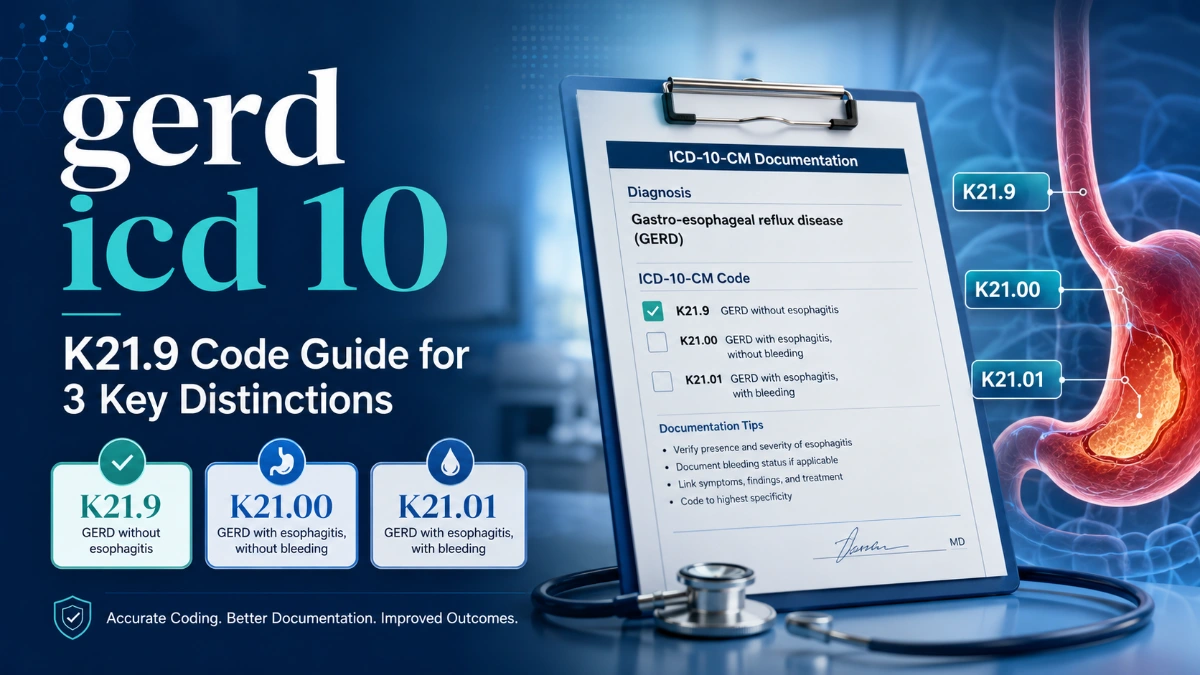
Current FY2026 code data confirms three distinct, billable codes in this family: K21.9 for GERD without esophagitis, K21.00 for GERD with esophagitis without bleeding, and K21.01 for GERD with esophagitis with bleeding.
Myth: Symptoms Alone Decide the Code
Myth: Severe or frequent heartburn means the esophagitis code should be used.
Fact: Esophagitis must be documented—often based on endoscopy findings or a clinician’s stated diagnosis—before a gerd icd 10 code moves beyond K21.9.
If endoscopy is negative or was not performed, and the provider documents GERD without describing esophagitis, K21.9 remains the applicable code.
Code Reference Table
| Code | Meaning | Documentation required | Billable status |
| K21.9 | GERD without esophagitis | GERD documented; esophagitis not documented | Billable/specific |
| K21.00 | GERD with esophagitis, without bleeding | Esophagitis documented by name; no bleeding documented | Billable/specific |
| K21.01 | GERD with esophagitis, with bleeding | Esophagitis and bleeding both documented | Billable/specific |
K21 and K21.0 alone are not billable; K21.0 requires a fifth-character code—K21.00 or K21.01—to be reportable.
Myth: K21.0 Can Be Used by Itself
Myth: K21.0 is a complete, reportable code for GERD with esophagitis.
Fact: K21.0 is a parent category. A gerd icd 10 diagnosis with esophagitis must be reported using K21.00 or K21.01, depending on bleeding status.
Common Coding Mistakes
- Coding K21.00 without a documented esophagitis diagnosis: the term “esophagitis” or clinical equivalent needs to appear in the documentation.
- Coding K21.01 from an unrelated bleeding note: bleeding must be clinically linked to the esophagitis diagnosis, not merely mentioned elsewhere in the chart.
- Defaulting to K21.9 out of convenience: K21.9 is correct only when esophagitis is genuinely not documented, not simply when documentation is incomplete.
- Stopping at K21 or K21.0: both require further specificity before they are billable.
- Assuming code severity mirrors symptom severity: the codes reflect documentation, not a clinical severity scale.
A Practical Checklist
Before finalizing a gerd icd 10 code, confirm:
- GERD is explicitly documented by the provider.
- The presence or absence of esophagitis is stated, not inferred from symptoms.
- If esophagitis is documented, bleeding status is also documented.
- The code selected has the required specificity (K21.9, K21.00, or K21.01), avoiding the non-billable K21 or K21.0 alone.
- Any documentation ambiguity is resolved through the applicable provider-query or coding policy rather than assumption.
What the Code Does Not Tell You
A gerd icd 10 code identifies a documented diagnosis category; it does not measure how disruptive symptoms are to daily life or dictate treatment.
Anyone experiencing new, worsening, or concerning digestive symptoms should consult a qualified healthcare professional, since a diagnosis code is an administrative classification rather than clinical guidance.
Frequently Asked Questions
K21.9 is the code for gastro-esophageal reflux disease without esophagitis.
Yes, K21.9 is a billable, specific ICD-10-CM code.
K21.00 is GERD with esophagitis without documented bleeding; K21.01 is GERD with esophagitis with documented bleeding.
No. K21.0 is a parent category; K21.00 or K21.01 must be used for a billable, specific diagnosis.
A negative or absent endoscopy alongside a GERD diagnosis without documented esophagitis is consistent with K21.9, subject to the provider’s documented assessment.
No. The code reflects documented esophagitis and bleeding status, not perceived symptom severity.
These codes remain active and unchanged in FY2026 coding materials, covering encounters from October 1, 2025 through September 30, 2026.