
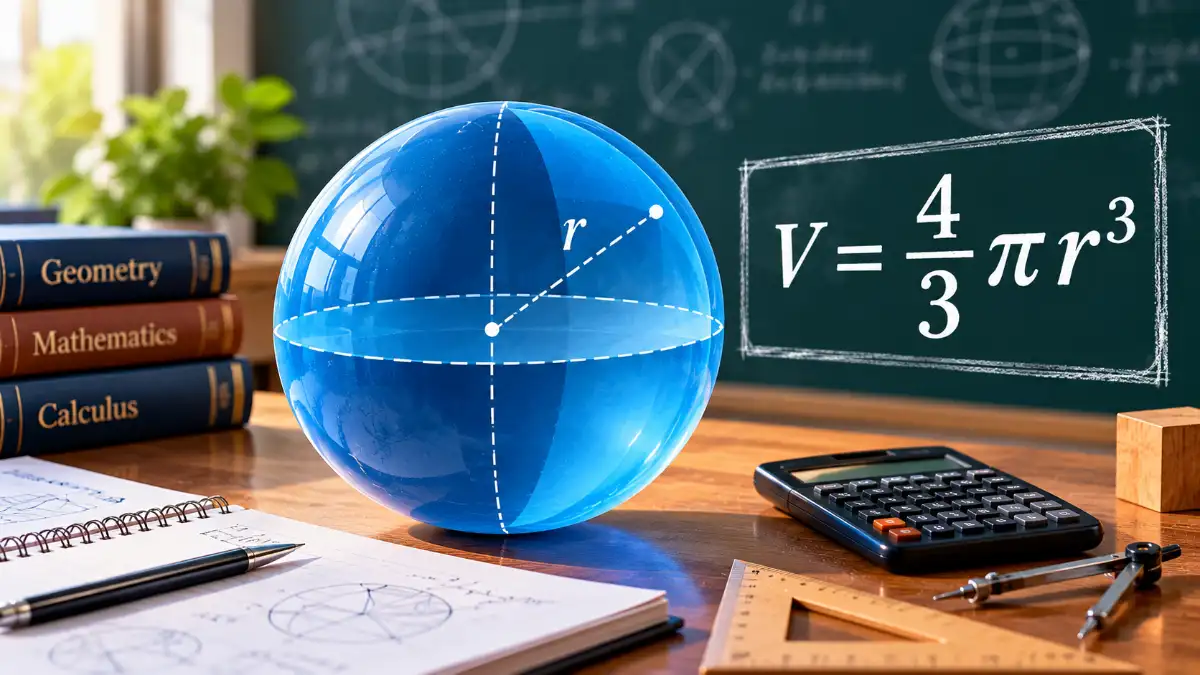
The sphere volume formula is V=43r3, where r is the radius, and π is approximately 3.14159. It works because the solid enclosed by a sphere occupies exactly two-thirds of the volume of a cylinder that fits tightly around it. That cylinder has the same radius as the sphere and a height equal to its diameter.
This relationship explains the factor of four-thirds in the equation. It can also be demonstrated through geometric reasoning and calculus.
Understanding why the formula works is useful when comparing three-dimensional shapes, calculating spherical container capacity, and solving problems involving volume and measurement accuracy.
How the Sphere-Cylinder Relationship Explains the Formula
Imagine placing a sphere of radius r inside a cylinder.
For the cylinder to fit tightly around the sphere, it must have a radius of r and a height of 2r.
The cylinder’s volume is:
Vcylinder=r2(2r)
Simplifying:
Vcylinder=2r3
A sphere occupies exactly two-thirds of this cylinder’s volume.
Therefore:
Vsphere=23(2r3)
\[ \boxed{V_{\text{sphere}}=\frac43\pi r^3} \]
This relationship is associated with the ancient Greek mathematician Archimedes, whose work on spheres and cylinders became an important achievement in classical geometry.
The relationship is mathematically exact when both solids have the specified dimensions.
Deriving Sphere Volume Using Cavalieri’s Principle
Cavalieri’s principle provides a geometric explanation without requiring integral calculus.
It states that two solids with equal heights have equal volumes when their cross-sectional areas match at every corresponding height.
We can use this principle to compare a hemisphere with a cylinder from which a cone has been removed.
Step 1: Examine a Hemisphere
Consider a hemisphere of radius r resting on its flat circular base.
Let z represent the height above the base, where:
0zr
Using the Pythagorean theorem, the radius of its horizontal circular cross-section is:
r2-z2
Therefore, the cross-sectional area is:
Ahemisphere=(r2-z2)
The area gradually decreases as the height approaches the hemisphere’s top.
Step 2: Compare a Cylinder and Cone
Now consider a cylinder with radius r and height r.
Inside it, place a cone with its vertex at the bottom center and its circular base covering the cylinder’s top.
At height z, the cylinder’s cross-sectional area is:
Acylinder=r2
The cone’s cross-sectional radius at that height is z, giving:
Acone=z2
Subtracting the cone’s area from the cylinder’s area:
Aremaining=r2-z2
Aremaining=(r2-z2)
Notice that this expression matches the hemisphere’s cross-sectional area exactly.
Step 3: Apply Cavalieri’s Principle
Since the cross-sectional areas match at every corresponding height, the two solids have equal volumes.
The cylinder’s volume is:
Vcylinder=r3
The cone’s volume is:
Vcone=13r3
Subtracting:
Vhemisphere=r3-13r3
Vhemisphere=23r3
A complete sphere consists of two hemispheres:
Vsphere=223r3
The result is:
\[ \boxed{V_{\text{sphere}}=\frac43\pi r^3} \]
This proof establishes the equation using known relationships between geometric solids.
Deriving the Formula With Calculus
Calculus offers another explanation by treating a sphere as a collection of extremely thin circular disks.
For a sphere centered at the origin:
x2+y2=r2
Rearranging:
y2=r2-x2
The cross-sectional area at position x is:
A(x)=(r2-x2)
Adding the disks through integration gives:
V=-rr(r2-x2)dx
Evaluating:
V=r2x-x33-rr
After substituting the limits:
V=2r3-23r3
Therefore:
\[ \boxed{V=\frac43\pi r^3} \]
Both approaches produce the same result. Cavalieri’s principle compares corresponding cross-sections, while calculus adds their areas continuously.
Comparing the Volumes of a Sphere, Cone, and Cylinder
A useful geometric relationship appears when a sphere, cone, and cylinder share the same radius r, while the cone and cylinder both have height 2r.
| Shape | Volume |
| Cone | 23r3 |
| Sphere | 43r3 |
| Cylinder | 2r3 |
Their volumes follow the ratio:
\[ \boxed{1:2:3} \]
The sphere has twice the cone’s volume and two-thirds of the cylinder’s volume.
However, this ratio applies only to solids with the specified dimensions.
Four Practical Applications of Sphere Volume
1. Calculating Spherical Container Capacity
Suppose a spherical container has an internal radius of 15 cm.
V=43(15)3
V=450014137.17cm3
Since 1,000 cubic centimeters equal one liter:
\[ \boxed{V\approx14.14\text{ L}} \]
This is the container’s theoretical internal capacity. Actual usable capacity may be lower because of fittings, openings, or irregularities.
2. Finding the Volume of a Metal Ball
Consider a solid metal ball with a radius of 4 cm.
V=43(4)3
\[ \boxed{V\approx268.08\text{ cm}^3} \]
If its material density is known, mass can be estimated using:
m=V
Here, represents density.
The calculation assumes the ball is approximately spherical and has reasonably uniform material density.
3. Understanding Water Displacement
A fully submerged, impermeable solid sphere displaces water equal to its external volume.
For a sphere with radius 3 cm:
V=43(3)3
V113.10cm3
Since 1 cm³ equals 1 mL, the displaced water volume is approximately 113.10 mL.
For a partially submerged sphere, only the underwater portion determines displacement.
4. Comparing Different Ball Sizes
Suppose two spherical balls have radii of 4 inches and 6 inches.
Their volume ratio is:
V2V1=643
\[ \boxed{\frac{V_2}{V_1}=3.375} \]
The larger ball has 3.375 times the volume of the smaller one, although its radius is only 1.5 times greater.
Why Accurate Radius Measurements Matter
Sphere volume depends on the cube of the radius. Consequently, small measurement errors can produce larger errors in calculated volume.
Suppose the measured radius is 1% too high.
The calculated volume changes by:
1.013=1.030301
That means the result is approximately 3.03% too high.
For small measurement errors, the percentage error in volume is approximately three times the percentage error in radius.
This matters when estimating materials, measuring precision components, or calculating container capacity. Using suitable measurement tools and avoiding premature rounding improves reliability.
Read more: Sphere Volume Formula
Frequently Asked Questions
Why does the sphere volume equation include four-thirds?
The factor comes from the geometric relationship between a sphere and its tightly enclosing cylinder, whose volume is 2r3.
Who discovered the classical sphere-cylinder volume relationship?
Archimedes is credited with establishing the classical relationship between the volumes of a sphere and its enclosing cylinder.
Can sphere volume be proved without calculus?
Yes. Cavalieri’s principle allows a geometric proof by comparing a hemisphere with a cylinder from which a cone is removed.
What is the formula for hemisphere volume?
A hemisphere has half the volume of a complete sphere:
V=23r3
What happens when the radius of a sphere triples?
Its volume increases 27 times because 33=27.
Can this formula estimate Earth’s volume?
Yes, approximately. Earth is not perfectly spherical, so more accurate calculations use a model that accounts for its slightly flattened shape.
Does the formula work for an ellipsoid?
An ellipsoid requires a different expression:
Here, a, b, and c represent its three semiaxes.
Divide the cubic-centimeter value by 1,000. For example, 2,500 cm³ equals 2.5 liters.
How do you calculate the material volume of a hollow spherical shell?
Subtract the inner spherical volume from the outer spherical volume:
V=43(R3-r3)
Here, R is the outer radius, and r is the inner radius.