
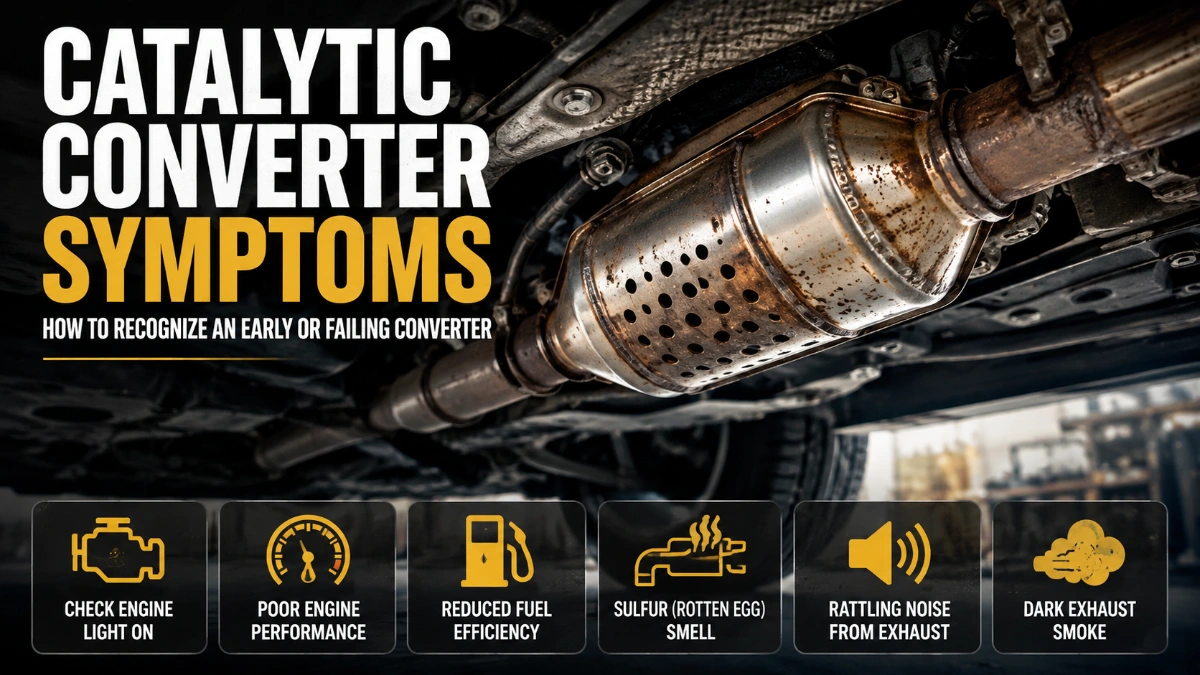
Catalytic Converter Symptoms: 7 Warning Signs That Demand Fast Action
Most drivers search for catalytic converter symptoms after noticing a check engine light, unusual exhaust smell, strange noise, reduced acceleration, or a change in fuel economy. The important point is that these signs do not automatically prove the catalytic converter has failed.
A problem with the engine, fuel system, oxygen sensors, wiring, or exhaust can produce similar warnings. The most useful approach is therefore to treat a symptom as evidence that the emissions system needs attention—not as a diagnosis by itself.
7 Catalytic Converter Symptoms at a Glance
The main warning signs include:
- Check engine light with a catalyst-related code such as P0420 or P0430
- Reduced power or sluggish acceleration
- Rotten-egg or sulfur odor
- Unexplained decline in fuel economy
- Rattling from the converter or exhaust area
- Failed emissions or inspection testing
- Excessive heat or a visibly glowing converter
Important: None of these signs alone proves that the converter needs replacement. Proper diagnosis should identify the underlying fault first.
1. Check Engine Light and P0420/P0430 Codes
One of the most recognizable catalytic converter symptoms is a check engine light accompanied by a code such as P0420 or P0430.
P0420 identifies catalyst-system efficiency below the expected threshold for Bank 1, while P0430 is the corresponding code for Bank 2. Modern OBD systems monitor emissions-related components and can monitor catalyst efficiency as part of their diagnostic functions.
However, P0420 or P0430 does not automatically mean the converter itself is defective. Exhaust leaks, oxygen-sensor faults, wiring problems, misfires, fueling issues, and other conditions can affect the readings used to evaluate catalyst performance.
Treat the code as a starting point for diagnosis rather than an instruction to replace an expensive component.
2. Reduced Power and Sluggish Acceleration
A physically damaged or restricted converter can interfere with exhaust flow and contribute to noticeable power loss.
You may experience:
- Sluggish acceleration
- Hesitation
- Difficulty maintaining power under load
- Poor performance when climbing hills
- Increasing loss of power as engine speed rises
Severe power loss is more concerning when it appears alongside other catalytic converter symptoms, but it is not exclusive to converter trouble. Ignition faults, fuel-delivery problems, intake problems, and other exhaust restrictions can cause similar behavior.
Can a clogged catalytic converter cause loss of power?
Yes. If internal catalyst material becomes damaged and restricts exhaust flow, the engine can struggle to expel exhaust gases efficiently. Because other problems can create the same symptom, restriction should be confirmed rather than assumed.
3. Sulfur or Rotten-Egg Smell
A persistent rotten-egg odor from the exhaust is commonly associated with hydrogen sulfide (H₂S) and sulfur-related exhaust chemistry.
The important diagnostic point is that the smell does not necessarily mean the converter itself has failed. Abnormal fueling or a rich-running condition can contribute to sulfur odors. EPA investigations have documented hydrogen-sulfide odor associated with improperly adjusted or malfunctioning vehicle systems.
If the odor is strong or persistent, the vehicle should be inspected for the underlying engine, fueling, or emissions-system problem.
4. Poor Fuel Economy
Poor fuel economy can accompany catalytic converter symptoms, but it is a relatively weak indicator by itself.
Fuel consumption can change because of:
- Driving conditions
- Tire pressure
- Traffic
- Weather
- Driving style
- Fuel-system problems
- Sensor faults
- Engine problems
- Exhaust restriction
A noticeable mileage drop becomes more meaningful when it occurs with a check engine light, power loss, misfire, unusual odor, or other diagnostic evidence.
5. Rattling Noise
A metallic rattle underneath the vehicle can occur when the ceramic or metallic internal substrate has broken apart. Loose material can vibrate inside the converter housing, particularly during startup, acceleration, or changes in engine speed.
But a converter is not the only possible source.
Heat shields, brackets, clamps, pipes, and other exhaust components can also create metallic rattles.
What does a catalytic converter rattle mean?
It can indicate damaged internal material, but the sound alone cannot identify the source. A persistent rattle deserves an inspection to determine whether it originates inside the converter or elsewhere in the exhaust system.
6. Failed Emissions Test
A failed emissions test is a strong external indicator that an emissions-control problem needs attention. Catalytic converters are designed to reduce pollutants such as hydrocarbons and carbon monoxide; three-way catalyst systems also address nitrogen oxides.
A catalyst that is no longer performing effectively can contribute to an emissions-test failure. However, oxygen sensors, fuel-control problems, misfires, exhaust leaks, and other emissions faults can also affect test results.
Therefore, an emissions failure should identify the need for diagnosis—not automatically identify the converter as the failed part.
7. Excessive Heat or a Glowing Converter
Excessive converter temperature is a more urgent warning than an ordinary check engine light.
A serious engine misfire or abnormal fueling condition can send unburned fuel into the exhaust, creating substantial thermal stress. EPA material has documented catalyst overheating associated with ignition-system failures and misfires.
A converter that is visibly glowing should therefore be treated as a sign of a potentially serious underlying engine or emissions problem.
Do not assume that replacing the converter alone will solve the issue. The condition causing the excessive heat also needs to be identified.
Which Symptoms Point Most Strongly to Converter Trouble?
Not all catalytic converter symptoms have equal diagnostic significance.
| Symptom | Diagnostic significance | Other possible causes |
| P0420/P0430 code | Moderate | Oxygen sensor, exhaust leak, wiring, catalyst deterioration |
| Rattling from converter area | Moderate to high | Heat shield or other exhaust hardware |
| Severe power loss | Moderate to high | Exhaust restriction, ignition or fueling problems |
| Rotten-egg odor | Moderate | Rich-running or combustion issue |
| Poor fuel economy | Low | Tires, driving conditions, fueling or sensor problems |
| Failed emissions test | Moderate to high | Other emissions-system faults |
| Glowing/red-hot converter | High urgency | Misfire, rich-running condition, severe catalyst overheating |
This distinction is important because a warning can indicate that the emissions system needs attention without proving that the converter itself has failed.
What Doesn’t Necessarily Mean the Converter Is Bad?
Several commonly reported warnings are easy to misinterpret.
P0420/P0430 alone: These codes indicate a catalyst-efficiency issue, not automatic proof of physical converter failure.
Poor fuel economy alone: Many engine, tire, driving, and maintenance factors can reduce mileage.
A rattling exhaust: Heat shields and other exhaust hardware can rattle.
Rotten-egg odor: Abnormal fueling or combustion conditions can contribute to sulfur odor.
Dark exhaust smoke: This should not automatically be blamed on the converter; it can point toward a rich-running or combustion-related problem.
This diagnostic distinction is one of the most important things to understand before authorizing an expensive repair.
What Causes Catalytic Converter Failure?
Understanding the cause is as important as identifying catalytic converter symptoms. A converter can be damaged by problems elsewhere in the vehicle.
Common contributors include:
- Repeated engine misfires: Unburned fuel can enter the exhaust and create excessive thermal stress.
- Rich-running conditions: Excess fuel can increase catalyst temperatures and affect emissions performance.
- Oil contamination: An engine that burns excessive oil can contaminate emissions-control components over time.
- Coolant contamination: Coolant entering the combustion chamber can damage emissions-control components.
- Exhaust leaks: Leaks near oxygen sensors can interfere with measurements used to evaluate catalyst performance.
- Physical impact: Road debris or other impacts can crack or crush internal catalyst material.
- Fuel or emissions-system problems: Incorrect fueling or other faults can place abnormal loads on the converter.
Replacing a converter without correcting the underlying cause can result in repeat failure.
Bad Catalytic Converter vs. Bad Oxygen Sensor
A catalyst-efficiency code does not automatically distinguish between a defective converter and another problem affecting the emissions-control system.
A proper diagnosis may consider:
| Possible problem | Why it matters |
| Catalytic converter deterioration | Catalyst may no longer achieve expected emissions performance |
| Oxygen-sensor problem | Incorrect sensor information can affect system evaluation |
| Exhaust leak | Outside air can affect oxygen readings |
| Engine misfire | Can damage the catalyst and create abnormal exhaust conditions |
| Fueling problem | Can alter exhaust composition and catalyst temperature |
| Wiring fault | Can interfere with sensor or emissions-system signals |
The correct repair depends on evidence from the vehicle rather than the code alone.
How Is a Bad Catalytic Converter Confirmed?
A technician may use several pieces of evidence rather than relying on one symptom.
- Read stored and pending OBD-II diagnostic codes.
- Check for misfires and other active engine faults.
- Inspect the exhaust for leaks or physical damage.
- Evaluate oxygen-sensor and fuel-trim data where appropriate.
- Check converter temperature under suitable operating conditions.
- Test exhaust backpressure when restriction is suspected.
- Identify whether an engine or fueling problem caused catalyst damage.
Not every vehicle requires every test. The diagnostic procedure should be appropriate for the vehicle and symptoms.
Simple Checks Before Professional Diagnosis
You can record useful observations without attempting an unsafe repair:
- Whether the check engine light is steady or flashing
- Which diagnostic codes are stored
- Whether the vehicle has lost power
- When the odor or noise occurs
- Whether the problem happens during startup, acceleration, or constant-speed driving
- Whether other engine symptoms appeared first
Avoid touching a recently driven exhaust system. Exhaust components can become extremely hot, and inspection underneath a vehicle requires an appropriate, safe setup.
When Should You Stop Driving?
Some catalytic converter symptoms warrant prompt professional attention rather than continued normal driving.
Arrange a diagnosis soon if you notice:
- A persistent check engine light with P0420/P0430
- Mild but worsening performance loss
- Persistent sulfur odor
- A new exhaust rattle
Seek prompt attention if you notice:
- Severe loss of engine power
- Repeated or significant engine misfires
- A converter becoming extremely hot or visibly glowing
- Strong fuel or exhaust odors accompanied by obvious engine problems
The urgency depends on the underlying fault, not simply on the presence of a catalyst-related code.
Frequently Asked Questions
A check engine light with a catalyst-efficiency code such as P0420 or P0430 can be an early clue. However, those codes do not prove the converter itself has failed.
It may continue to run when the converter has lost efficiency without becoming restricted. A severely damaged or blocked converter can cause major power loss, so the vehicle should be diagnosed based on the severity and combination of symptoms.
No. P0420 indicates that the catalyst system’s measured efficiency is below the expected threshold. Oxygen sensors, exhaust leaks, wiring, misfires, fueling problems, and other faults should also be considered.
The odor is associated with hydrogen sulfide and sulfur-related exhaust chemistry. A rich-running engine or other combustion/fueling problem can contribute, so the smell should not automatically be blamed on the converter.
A rattle can indicate broken internal material, but it can also come from another exhaust component. Persistent rattling deserves an inspection, particularly if power loss develops.
There is no universal mileage or age at which every converter must be replaced. Service life depends on vehicle design, engine condition, operating conditions, contamination, misfires, and physical damage.
It can. A converter that is no longer reducing pollutants effectively may contribute to an emissions-test failure, although other emissions-system faults can also cause a failed result.